Sunday, May 2, 2010

Spring menu

Earlier this week, we went to the Purple Pig (see a friend's review here), where we had a truly fantastic, seasonal meal full of ingredients like asparagus, peas, ramps, rock shrimp, and fava beans all dowsed in a healthy dose of lemon. That put me in the mode to do a few spring dishes, so, yesterday, we had a couple people over for a big spring dinner. Here's the menu: cannellini bean salad with grilled tuna and endives, a shaved asparagus and pecorino salad, confit pork belly with fennel pollen and spicy piquillo aioli, seared scallops with meuniere sauce, langoustines a la plancha with anchovy and caper butter, minted pea ravioli with shaved parmigiano-reggiano, mint, chives, chive blossoms, and truffle oil, heirloom potatoes roasted in duck fat with garlic confit and thyme, and lake trout, roasted whole with lemon, served with classic aioli and a roasted red pepper, piquillo, and miso sauce. We served it with the following wines, which I thought were all pretty good: 2007 Cellar Can Blau Montsant, 2007 Pio Cesare Cortese di Gavi, and 2007 Domaine de la Villaudiere Sancerre. Yes, it was a lot of food.

We didn't get a picture of the cannellini bean salad, but you can get the recipe from an earlier post.
We got the asparagus salad idea from our meal at the Purple Pig. It's similar to a brussels sprout salad that we make a lot.
INGREDIENTS
1 bunch asparagus
1-2 lemons
Extra virgin olive oil (preferably Tuscan or something with nice grassy notes to it)
Pecorino-romano
Salt, pepper

Break off the ends of the asparagus stalks, slice thin, on a bias. To make slicing easier, keep the asparagus bound by the rubber band that it comes with. Since this is a raw preparation, you want to cut the asparagus as thin as possible so it won't be too tough. Use a mandoline if you have one.

Add the zest and juice from one to two lemons. Add about 2-3 tablespoons of olive oil along with about 1/4 to 1/2 cup of grated cheese. Season with salt and pepper. Add more olive oil and lemon juice if necessary. The amount of lemon to add depends on your preferences. This should have a very "bright" taste to it, so the juice from 1.5 to 2 lemons is probably best.

We got bits of pork belly from a butchering demonstration at Mado, which I'll post more on latter. The recipe comes from Ad-Hoc At Home, so I won't repeat it here. I served it with a spicy aioli that was left over from a yet to be posted meal.

The scallops, along with the langoustines, were impulse buys from our trip to Isaacson and Stein. They had big tubs full of big, fresh scallops and lovely, lovely langoustines. The scallops were given a quick salt water brine, then dried off in the fridge for a couple hours. I seared them over medium high heat in clarified butter. To make the meuniere sauce, simply add lemon juice, capers, and parsley to the butter and swirl around for a minute or so to emulsify the mixture a bit.The langoustines were definitely the highlight of the meal. We first had this dish at Prune, and we've bean wanting it again ever since.
INGREDIENTS
langoustines
butter
anchovies
capers
lemon
salt

Brine the langoustines in a salt water solution (2 cups water to 5 oz. salt) for 10 to 15 minutes and pat dry with paper toils.

Get a cast iron griddle piping hot. It may take up to 5 minutes. Turn your fan on, open the doors and windows. This will create a lot of smoke. Spread clarified butter over the cooking surface and immediately add the langoustines. If the smoke gets too out of control, turn the heat down a bit. Cook the shrimp for about 6 to 7 minutes on each side. While the langoustines are cooking, melt a stick of butter in a small sauce pan. Add about 10 anchovy fillets and crush in the pan with the melted butter until they break up into really small pieces. Add capers.

When the langoustines are done, place them on a serving plate, season with sea salt, pour half the butter over the top, and reserve the other half in a separate bowl for dipping. Serve lemon wedges on the side. Try to contain yourself.

We didn't get a picture of the ravioli. It is similar to this dish, but I added ricotta to the stuffing and took advantage of the community garden that has a bunch of blossoming chives right now.
For the fish, I just used this recipe, but I increased the cooking time to 50 minutes since this was one huge fish. It probably could have used another 10 minutes in the oven. I served it with a classic aioli and a red pepper sauce (you can find the recipe here). I really love this sauce. It goes great with grilled and roasted vegetables and meats and will probably be a staple of my summer cooking.

Tuesday, April 27, 2010

Handmade spaghetti with ramps

Signs of spring have finally begun to show up in the local grocery stores. The other week, I bought a bunch of English peas at the market, and yesterday, the market had a bunch of ramps.
Ramps with spaghetti is a pretty classic combination, and I think that they go especially well with fresh pasta.
RECIPE (2 servings):
1 cup flour
2 eggs
2 bunches of ramps (about 16)
1-2 strips bacon (optional)
salt
pepper
red pepper flakes
grated parmesan cheese

Form the flour into a mound and create a well in the middle. Add the eggs to the well along with a pinch of salt. You can also add some pepper at this stage if you like. Beat the eggs, slowly incorporating the flour. Knead the dough for about 5 to 10 minutes. Keep adding flour if the dough feels too wet. Wrap in plastic wrap and let rest for at least 30 minutes. After resting, roll out the pasta and cut it to the desired width.

While the pasta is resting, bring a large pot of water to boil and add a generous amount of salt. Rinse the ramps thoroughly, and cut them in half crosswise to separate the leaves from the bulbs. Cut the root ends off of the bulbs and wipe off the outer layer of skin on the bulbs. When the water has reached a rapid boil, blanch the root ends until tender (about 4 to 5 minutes). Remove and place in an ice bath to stop the cooking, then let drain in a colander. Blanch the leaves for about 30 seconds, place in an ice bath and drain.

Meanwhile, cook the bacon. When the bacon is crisp, remove and drain on paper towels and then crumble into small bits. Remove any excess fat, leaving 1/2 to 1 tablespoon in the pan.

For the final step, you need to do a couple things really quickly. You don't want to over cook anything, so pay attention to timing here. Make sure the pasta is at a very rapid boil, and add the pasta. Next, add a pinch of red pepper flakes and saute for about 30 seconds over medium high heat. Add the ramps and the crumbled bacon, and saute over high heat for about two minutes, tossing frequently. After the pasta has been cooking for two to three minutes, it will be done. Reserve about 1 cup of pasta water, then add the cooked pasta to the saute pan, and toss thoroughly along with about 1/4 cup of grated parmesan cheese and pepper. Add a bit of pasta water if the mixture looks to dry, and keep tossing the mixture until everything is well incorporated. Serve immediately.

Saturday, April 17, 2010

Paella meets risotto with beet salad

This dinner was a bit of a pantry raid. I didn't feel like going to the store, but we had some beets, radishes, and guanciale in the fridge and some shrimp and peas in the freezer. I started out thinking I would do a risotto with shrimp and peas, which is something I've made several times before, but then I realized that I had some guanciale in the fridge and a bunch of saffron in the pantry, so I decided to go a different route and make a "paella inspired" risotto. The result actually turned out pretty good.

RECIPE:
-3 to 4 oz. guanciale, diced into 0.5 cm squares (you can substitute pancetta or chorizo)
-1/2 white onion, fine dice
-3 cloves garlic, minced
-1/2 to 1 tsp saffron
-3 sprigs thyme
-1 cup arborio rice
-1/4 cup grate parmesan
-2 Tbsp creme freche
-1 cup peas
-6 jumbo shrimp, shells off and cut into 4 pieces (or an equivalent amount of smaller shrimp)
-salt, pepper
-1/8 to 1/4 cup white wine

Heat up 4 to 6 cups of chicken stock. Put the thyme sprigs in with the stock so that the cooking liquid becomes infused with the thyme flavor,

In a separate, medium sized pot, heat up a little bit of olive oil over medium high to high heat. Add the guanciale and cook until the fat has rendered and you are left with crispy little bits of guanciale. If the oil begins smoking, turn the heat down. Remove the guanciale and drain on paper towels.

Turn the heat down to medium and pour out any excess fat. You only want about 1 T in the pan. Add the onions and garlic and cook, stirring occasionally, until the onions are translucent. If the onions begin to brown, turn the heat down. After about 5 to 6 minutes, add the saffron and continue to cook for another minute or two. Add the rice and cook for another minute, stirring frequently to coat the rice.

Add the white wine, stirring constantly until the wine is absorbed, then begin adding chicken stock, 1.2 to 1 ladel full at a time. Keep stirring the risotto. After about 15 to 20 minutes, begin checking the rice. Keep adding the liquid and stirring until the risotto is done. You want to get the rice to a point where it still has some bite, but the interior is no longer chalky.

While you are cooking the rice, cook the shrimp. Since shrimp are usually previously frozen, they tend to be waterlogged, so to cook them properly, you will need to cook them in small batches in a screaming hot pan. The shrimp will give off a lot of water, cooling the pan down, and it will be difficult to get them to cook right if the pan is too crowded. You may end up stewing or steaming the shrimp instead of searing them, and they won't taste nearly as good. When the shrimp are nearly cooked, add a small pat of butter. You don't want to add the butter beforehand or it will scorch. Drain the shrimp on paper towels and sprinkle a pinch of salt over them.

Once the risotto is done, stir in the grated parmesan and creme freche. This gives the risotto a nice, creamy finish. Season to taste with salt and pepper and stir in the peas, guanciale, and shrimp. If the risotto is too thick, stir in a bit more stock. The risotto should be runny, and not have enough body to stand up on its own.

The recipe for the beat salad is a bit simpler: roast beats, peel and cube, toss with orange zest, some orange juice, olive oil, and red wine vinegar. Add sliced radishes and pieces of orange. Chill for at least one hour. Serve at room temperature.

Friday, April 16, 2010

Bibimbap

I went to an Asian market earlier this week and picked up a couple of dolsot (stone bowls), so I could make some legit bibimbap. Here's a picture of the finished product.

Thursday, April 15, 2010

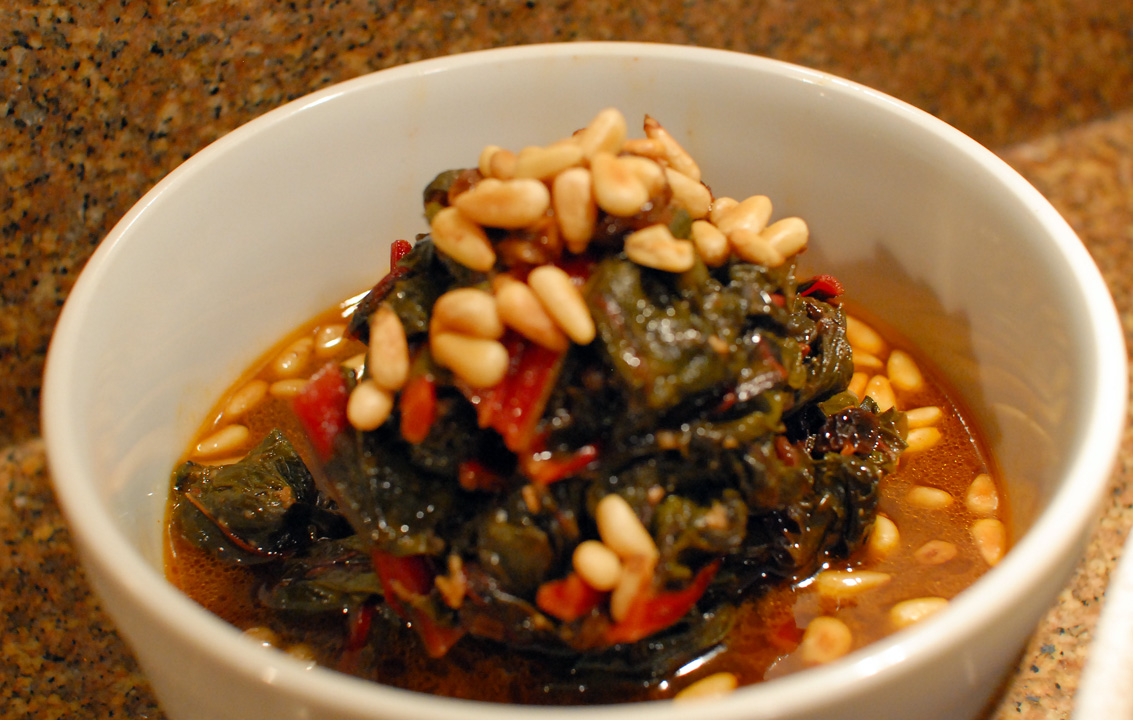
Roasted branzino with lemon and capers, Braised chard with pine nuts and raisins

Few things are easier to make than a roasted fish. For this dish, I just seasoned the fish with salt and pepper, fill the cavity with lemon slices, rosemary, basil, and thyme, place the fish on top of slices of lemon and place another layer of thinly sliced lemon on top, cover with 1/4 cup olive oil, and add another 1/4 to 1/3 cup of white wine to the roasting pan along with some capers and olives, if you have them. Roast the fish at 400F for 20 to 30 minutes, and use the reserved liquid from the roasting pan as a sauce.

Chard is a nice accompaniment to the fish. Start by rinsing the chard and slicing it into strips that are about 1" wide. Saute with olive oil and garlic. Season with salt (I used smoked salt), paprika and a pinch of red pepper flakes. Add a splash of white wine and about 1/4 cup of water or broth along with a handful of raisins. Cover and let simmer for around 20 minutes. When the chard is done cooking, garnish it with toasted pine nuts.

Tuesday, April 13, 2010

Ceviche

The last couple of times I've been to Isaacson & Stein, they've had some nice looking corvina, a white fish that is commonly used to make ceviche. So, of course, Abby and I had to try our hand. This picture comes from our second batch of ceviche. The first time around, we just used the corvina, but we added shrimp and scallops to this batch.
RECIPE:
-1/2 lb corvina
-1/4 lb shrimp
-1/4 lb scallops
-1 serrano pepper (minced)
-6 limes
-1 lemon
-2 shallots
-1/8 cup chopped cilantro
-1 Tbsp basil (chiffonade)
-2 shinly sliced radishes
-1 green onion, thinly sliced
-salt, pepper
-olive oil

Cut the fish, shrimp, and scallops in cubes (about 1cm). Season with a pinch of salt and pepper. Cut the shallots in half, lengthwise, and then cut into long strips. Toss together the seafood, shallots, serrano pepper, radishes, and green onion. Reserve the zest from one lime and one lemon, squeeze the juice from the lemons and limes and add to the fish mixture along with the zest. Mix together, cover, and refrigerate for 3 hours. Make sure there is enough liquid to cover most of the fish, and check in on the ceviche occasionally to give it a stir. Keep tasting the fish until it has "cooked" to your liking. When it is ready, stir in the basil and cilantro. Season with more salt if necessary, and garnish with olive oil. Serve with corn chips to add some texture.