Showing posts with label greens. Show all posts

Monday, December 13, 2010

Last dinner in my Chicago kitchen

Here's the last dinner I made in my Chicago kitchen. Tomato salad, braised greens, grilled corn with chile and lime, and grilled steak. It was a bit of an eclectic mix. But it used up the last of the vegetables in the fridge.


The tomato salad was pretty straight forward. Just slice up the tomatos, mix with thinly sliced shallots, capers, olive oil, vinegar, salt and pepper.
The greens (purple kale) were braised in some pork stock and a smoked ham hoc that had been sitting in my freezer. I also added some red pepper flakes and raisins. The raisins add a nice bit of sweetness and they soak up a lot of the savory flavors from the braising liquid. To make this dish, you want to start by sauting one bunch of sliced up kale along with a few cloves of sliced garlic. Add the stock, ham hoc, raisins, red pepper flakes, and maybe a tablespoon of cider vinegar. Let this simmer for a while (until the greens are very soft), remove the ham hoc, pick off the meat and toss this in with the greens.
I served the corn with a chile lime spread. I made the spread by mixing melted or softened butter with mayo in about a 1 to 3 ratio, and then adding lime juice and Mexican chile powder. Slathered over some grilled corn, this stuff is really, really good.


Sunday, December 12, 2010

Grilled pork tenderloin with apple cider reduction, grilled sweet potato with rosemary, and wilted escarole with garlic chips

Here's another dish from back in Chicago. It's been a while, so I don't remember all the details, for the escarole, tenderloin and sauce. The sweet potatoes couldn't be easier though. Just chop up some rosemary, mix it in with olive oil, and toss this mixture together with some sliced rounds of sweet potato. Grill until finished. This is one of my favorite side dishes for summer grilling.

Thursday, April 15, 2010

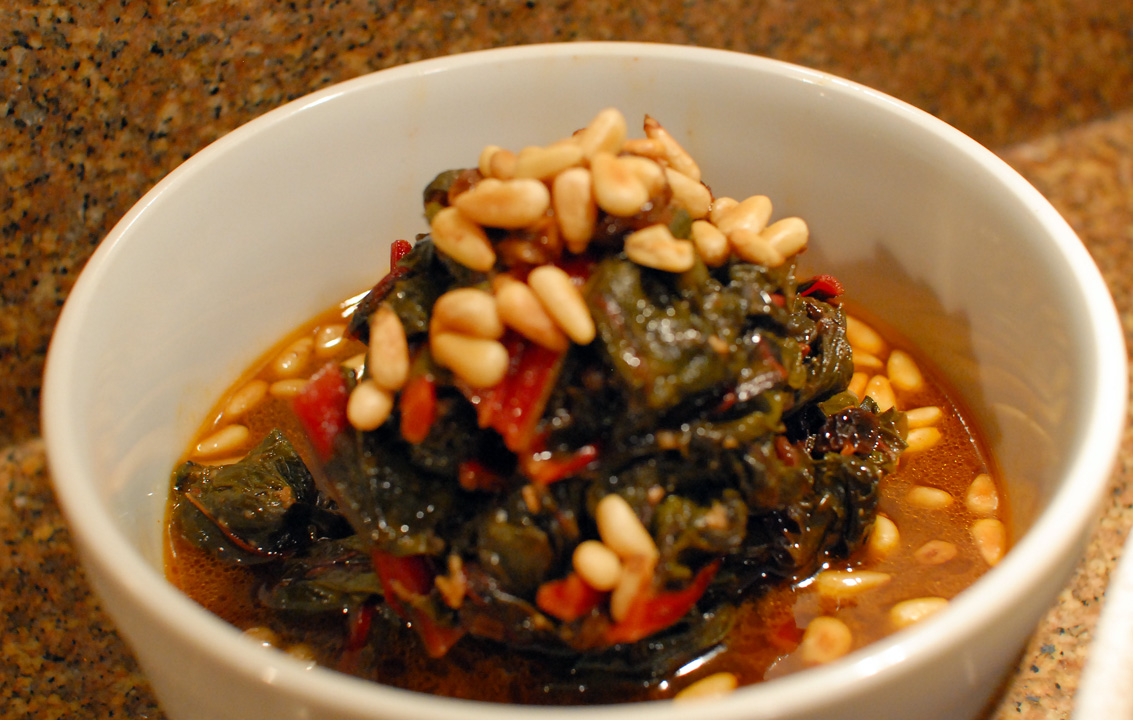
Roasted branzino with lemon and capers, Braised chard with pine nuts and raisins

Few things are easier to make than a roasted fish. For this dish, I just seasoned the fish with salt and pepper, fill the cavity with lemon slices, rosemary, basil, and thyme, place the fish on top of slices of lemon and place another layer of thinly sliced lemon on top, cover with 1/4 cup olive oil, and add another 1/4 to 1/3 cup of white wine to the roasting pan along with some capers and olives, if you have them. Roast the fish at 400F for 20 to 30 minutes, and use the reserved liquid from the roasting pan as a sauce.

Chard is a nice accompaniment to the fish. Start by rinsing the chard and slicing it into strips that are about 1" wide. Saute with olive oil and garlic. Season with salt (I used smoked salt), paprika and a pinch of red pepper flakes. Add a splash of white wine and about 1/4 cup of water or broth along with a handful of raisins. Cover and let simmer for around 20 minutes. When the chard is done cooking, garnish it with toasted pine nuts.

Saturday, January 30, 2010

Roasted chickpeas, swiss chard, and lamb sausage

This meal is quick enough to do on a weeknight. I've made a variation of this same chickepea dish here, and I've made several variations of chickpeas and greens here. Usually I stew the chickpeas with the greens, but this time I roasted the chickpeas with some olive oil, garlic, salt, pepper, cumin, and paprika. For the chard, I just seared them with some olive oil, garlic, and red wine vinegar. To cook the sausage, just throw them in the oven along with the chickpeas. This only takes a few minutes of prep time.

RECIPE:
1 large can chickpeas
1-2 bunches of Swiss chard
2 lamb sausages
Olive oil
6 cloves garlic, minced
1 tsp cumin
1 tsp paprika
1-2 tsp red wine vinegar
salt, pepper

Preheat the oven to 350F. Drain and rinse the chickpeas. Toss together with olive oil, half of the garlic, cumin, paprika, and add salt and pepper to taste (toast the spices before using them to bring out the flavors). Place the chickpeas and sausages on a baking sheet/pan and roast for about 30 minutes.

While the chickpeas are roasting, rinse the chard, cut off the thick stalks, and cut crosswise into 1 to 2 inch strips. Heat up about 1 to 2 Tbsp of olive oil over high heat in a large saute pan. Add the remaining garlic. After a few seconds, when the garlic begins to brown, add the chard in batches. It will cook down fairly quickly. Season with salt, pepper, and red wine vinegar. You only need to cook the chard for about 5 to 10 minutes.

When everything is done, mix together the chard and chickpeas. Serve with the lamb sausage.

Monday, January 11, 2010

Top Chef Finale Dinner

Abby and I had a couple friends over for the Top Chef finale. I didn't get many great pictures, but you can check on one of our guests' blogs for an account. We forgot to record the episode of Top Chef, so we were never actually able to watch the show on our "Top Chef Dinner Night." At least the food was good.

Sunday, July 12, 2009

Pan fried blue fish, chickpeas and spinach, and roasted asparagus

It's been a busy month, so I haven't been posting much lately, but I have managed to cook a couple meals here and there. This dish uses the same chickpea and spinach recipe from my last post. The blue fish is a preparation that I've used a couple other times on this blog. Just season with salt and pepper, dredge in flour, and pan fry in olive oil. This gives the fish a nice crispy texture. It works well with any white fish. I decided to give blue fish a try since it was one of the cheaper fish at the market that day. Blue fish is a bit oilier than most fish, but it doesn't taste quite as fishy as mackerel. For the asparagus, just toss with a bit of olive oil and season with salt, pepper, and a dash of cayenne pepper. Roast at 350F until done (about 30 min).

Sunday, June 14, 2009

Grilled Lamb with Spinach and Chickpea Stew

INGREDIENTS
  • lamb chops
  • 3 sprigs rosemary
  • 7 cloves garlic
  • olive oil
  • 1/2 lemon
  • salt, pepper
  • chickpeas
  • carrot
  • celery stalk
  • 2 bay leaves
  • 1 onion
  • 1 bag spinach
  • 1 tsp cumin
  • 1 tsp smoke paprika
  • 1 tsp corrianger
  • 1/2 tsp urfa peppers
  • stock

The night before, soak dried chickpeas in water and leave overnight.
In a food processor, combine 4 cloves garlic, rosemary, olive oil (about 1/4 cup), and juice from 1/2 lemon. Marinade lamb in this mixture overnight or at least for 2 hours.
After chickpeas have soaked, simmer with roughly chopped carrot, celery stalk, 1/2 onion, one crushed garlic clove, and two bay leaves. After an hour or two, drain the chickpeas and separate the chickpeas from the other ingredients.
Mince two more cloves of garlic, dice 1/2 onion, and cook in a saucepan over medium heat with 1 T olive oil. When the onions are soft, add chickpeas, spices, and chicken or vegetable stock to just cover the chickpeas. Let simmer over low heat for about 20 minutes. Add spinach in batches and let it cook down. Season with salt and pepper.
While the chickpeas are simmering, grill the lamb chops. Serve with olive oil and lemon.

Friday, May 15, 2009

Shrimp & grits with collard greens

I haven't cooked a ton of Southern food in the past, but we had a bunch of collard greens from this weeks produce delivery, so I figured it would go well with this dish. A basic version of shrimp and grits is really easy to make...just cook the grits and add shrimp, but it's really good to dress it up with a little Cajun style stew. A lot of recipes use milk as the basis for the grits, but I choose to make a homemade shrimp stock using a bunch of shells from some Main shrimp that had been sitting in the freezer. Here's my take on this Southern classic.

INGREDIENTS:
  • Shrimp (about 4-6 per serving)
  • 1/2 red bell pepper (small dice)
  • 1 stalk celery (small dice)
  • 1/2 vidalia onion (small dice)
  • tasso (small dice)
  • 2-3 Tbsp flour
  • 2-3 Tbsp butter, + 2 Tbsp butter
  • 1/4 cup whole milk
  • 5-6 cups shrimp stock
  • 1 cup course ground corn meal
  • salt
  • pepper
  • Cajun seasoning
  • 2 cloves garlic, sliced
  • red pepper flakes
  • lemon
  • 1 bunch collards, sliced into 1/2 to 1" strips
Directions for the stew
Melt the butter in a pan over medium high heat. Once melted, add an equal measure of flower and stir together. Keep cooking and stirring the roux until it becomes a very dark brown. Add the diced trinity (bell pepper, onion, and celery) and cook until soft (about 3 minutes). Add the diced tasso (Dice an amount that is equal to the amount of bell pepper, celery, OR onions. You want all four of the ingredients to be in equal parts). Cook for another 2 minutes. Season with cajun seasoning (~1/2 tsp), salt and pepper. Add the milk a little bit at a time, stirring constantly. Then add about 1 cup of the shrimp stock. Let simmer.

Directions for grits
Bring about 4 cups shrimp stock to a boil. Add 1 cup corn meal and stir. Keep stirring as the corn meal absorbs the liquid and the mixture begins to thicken. Season with salt and pepper. Once it is at a porridge like consistency, add 2 T butter and 1/2 -1 cup grated cheddar cheese. Season to taste with salt and pepper.

Directions for collards
Cut out think stems and slice collards across into 1/2" to 1" strips. Heat up 1 T olive oil in a pan and add 2 cloves minced garlic and a dash of red pepper flakes. When the garlic begins to brown, add the collards. After 1 to 2 minutes, add about 1/2 cup water or chicken stock. Turn the heat down to medium, cover, and let simmer. Before serving, toss a bit of lemon juice or cider vinegar in with the greens.

Directions for shrimp
Heat up 1 T butter over high heat. Add 1 clove on minced garlic and cook for 30 seconds. If the butter begins to brown, turn the heat down a little. Add the peeled, deveined shrimp and saute for about 1 minute. Add the shrimp to the stew.

To serve, add a few spoonfuls of grits to a bowl or plate and top with the shrimp/stew mixture and collards. Serve with lemon slices.

Thursday, May 14, 2009

Orange glazed pork belly with assorted greens

Staying with the local theme we've been on for the last couple weeks, this meal uses some salad greens from our local organic produce delivery and pork belly from Savenor's Vermont supplier.

I used this recipe and didn't bother making any changes, so just click through for the recipe. It takes a bit of time since you have to braise it, but the actual active prep time is fairly low.

Thursday, May 7, 2009

Pork loin chop, swiss chard, celeriac and turnip gratin

The major components of this meal were all local. The veggies were from the Boston Organics local delivery box and the pork comes from a farm in Vermont that Savenor's has recently started sourcing from. Here's the recipe.
INGREDIENTS:
  • 2 pork chops
  • salt
  • pepper
  • fennel pollen
  • white wine
  • 1 T butter
  • 1 bunch swiss chard
  • 5 cloves garlic
  • red pepper flakes
  • red wine vinegar
  • 1 celery root
  • 1 turnip
  • 1-1.5 cups cream
  • gruyere
Slice the celery root and turnip into 1/8" rounds (use a mandoline if you have one). Add to a pot with the cream and 3 cloves of smashed garlic. Season with salt and pepper. Bring to a boil, then reduce and simmer for 10 minutes. Butter a gratin pan and add the celery root, turnip and cream mixture. Grate enough gruyere cheese on top to cover. Bake at 350F for 40 minutes. Let stand at least 15 minutes before serving.

Rinse the chard, cut off thick stems, cut into 1" strips. Heat up 1 T olive oil in a saute pan, add 2 cloves of minced garlic and a dash of red pepper flakes and cook over medium high heat until the garlic begins to take some color. Add the chard. Season with salt and pepper. Let the chard cook down a little then add a splash of white wine. Let this cook down some more. Add about 2 tsp to 1 Tbsp of vinegar. 

Season the pork chops with salt, pepper, and fennel pollen. Add to cold pan and turn heat to high. Cook for about 2-3 minutes on the first side, flip, and cook another 2-3 minutes on the other side. Cooking times will vary depending on how thick the cut is. Remove the pork chops and let rest. Add 1/2 cup of white wine to the pan and scrape up anything stock to the pan. Mount with 1 Tbsp butter. Serve the pan sauce with the pork.

Monday, April 20, 2009

Seared tuna, crispy rice cakes, and sesame spinach


INGREDIENTS
Tuna
  • 2 servings tuna
  • sesame seeds
Spinach
  • Baby spinach (enough for 2 servings)
  • 1 carrot
  • 1 Tbsp toasted sesame seeds
  • 1 Tbsp soy sauce
  • 1 tsp rice vinegar
  • 1/2 tsp dashi
  • 1 clove minced garlic
Rice cakes
  • 1.5 cups sushi rice
  • 1-2 Tbsp rice vinegar
  • Rice seasoning (Furikake), to taste
Cook the rice. Let it cool to and add vinegar as if you are making sushi rice. Mix in furikake to taste. Form the rice into patties and cook until crispy and golden brown on each side.

Julienne the carrot and cook until soft with a little oil. Add minced garlic and spinach. Cook until wilted. In a bowl, grind up the sesame seeds and mix in the soy sauce, vinegar, and dashi. Add this to the spinach and toss together.

Season the tuna with salt and pepper and coat one side with sesame seeds. Sear over high heat for one minute on each side.

(Pictured with a sauce made of miso, soy, dashi, ponzu, sake, and mirin)

Sunday, April 5, 2009

Braised rabbit legs with chickpeas and swiss chard

Our fridge had been near empty for quite some time now, so yesterday we went to Market Basket for a long overdue restocking. I had some nice chard that I wanted to make with chickpeas, and I just needed one last piece to go with it. While I've had rabbit a few times in restaurants, I've never actually prepared it myself, so when I saw rabbit legs at Savenor's, I figured that would be the perfect piece to finish off the dish. Here's the recipe.

INGREDIENTS (for two):
(Rabbit)
  • 2 rabbit legs
  • flour
  • salt, pepper
  • 1/2 small to medium onion, diced
  • 1 carrot, chopped
  • 3 cloves garlic, peeled and smashed
  • 2 sprigs thyme
  • 1 bay leaf
  • 1 T black peppercorns
  • chicken stock
  • 1/2 C red wine
  • 2 T vinegar (I used orange-champagne vinegar, you can use red wine or cider vinegars)
(Chickpeas and Chard - double the portions if you are serving this as a main course for a vegetarian meal)
  • 1 bunch of Swiss chard
  • 1 12 oz. can of chickpeas, drained
  • 2 shallots, minced
  • 8 cloves garlic
  • 1 bay leaves
  • chicken stock
  • lemon zest
  • olive oil
Directions

Season the rabbit with salt and pepper, dredge in flour, and brown in a heavy pot with olive oil over medium high heat, large enough to hold the rabbit in a single layer. Cook for about 2 minutes on each side, adjusting the heat so the flour does not burn. Set the rabbit aside and cook the carrots, onions, and garlic until soft (about 10 minutes over medium heat). Add about 1/2 cup red wine and let reduce. Add the bay leaf, thyme, and peppercorns. Place the rabbit legs on top of the vegetables, flesh side down and add enough chicken stock just to cover. Cover the pot and braise for 45 minutes at 300F. After 45 minutes, add the vinegar, turn the rabbit legs, and braise for another 45 minutes to an hour.

When the rabbit is done, set the rabbit aside on a plate and strain the braising liquid into a sauce pan. Here, you can take a number of options. You can add a spoon full of mustard, chopped up herbs (tarragon would be great), or spices (a dash of curry powder might work). Reduce over high heat until the sauce starts to thicken (if you are using delicate herbs, add these right before serving), then adjust the seasoning with salt, pepper, and more vinegar if necessary.

For the chard and chickpeas, start by rinsing the chickpeas and in a baking dish, combine the chickpeas with 1 minced shallot, bay leaves, and 5 of the garlic cloves. Season with salt and pepper and drizzle with a generous portion of olive oil. Mix everything together, cover with foil, and bake on the top rack of the oven for 20 minutes. After 20 minutes, remove the foil and bake for another 30 minutes. Meanwhile, cut the thick stalks out of the chard and rinse thoroughly. Rip or slice the leaves into smaller pieces and let dry. Thinly slice the remaining 3 cloves of garlic and cook in a large saute pan over medium high heat with the shallots and 1 T olive oil. When the shallots and garlic begin to brown, begin adding the chard. Once all of the chard is cooked down, add 1/2 cup chicken or veggie broth and let simmer for 10 to 15 minutes over medium to low heat. Add the roasted chickpeas to the saute pan and cook together for another 10 minutes.

Wednesday, December 24, 2008

Cider braised pork shoulder with greens and polenta

I made this dish a couple weeks ago and haven't gotten around to posting it since Abby and I have been pretty busy. Now we're back in Washington state for Christmas and I have a bit of down time before I start making Christmas eve dinner, which will be based on this meal.

A meal like this is great for several reasons during this fall/winter season. Most importantly, it tastes really great and is easy to make. Second, braised dishes and stews just seem more appropriate when the weather is cold. And, third, it uses really cheap ingredients, which is always a plus if you are trying to stretch your dollars. This last point should come as no surprise. A lot of the best home cooking was developed to make the best out of cheap ingredients. Here, I use a cut of pork that you can find for $2/pound at most places, greens, which are fairly cheap, and polenta, which is just corn meal. Again, very cheap stuff. All of the components of the dish keep really well too, so you can economize on both time and money, making a big batch of food one day and stretching it out over a couple of meals. The pork actually gets better the next day, and you can reheat it in the braising liquid and serve it the same way, or you can shred it and make a sandwich out of it. For the left over polenta, the best thing to do is spread it out in a layer (about 1/2 thick) on a nonstick surface (a baking sheet or frying pan will do) and let it set. Once the polenta is firm, you can cut it into smaller pieces and store it in the fridge. Reheat it with a little oil using a grill pan or nonstick frying pan. These polenta cakes make a nice snack, and are great with the leftover pork.

Here's the recipe for the pork.

INGREDIENTS:
Pork shoulder or pork butt (~3 lb)
1 onion
Apple cider
Chicken broth/stock
a few sprigs of thyme
2 T cider vinegar
1 head garlic
2 bay leaves
1 T peppercorns
2 t fennel seeds
1 t mustard seeds
4 T demi glace
1 carrot

Start by covering the pork with salt and pepper and browning on all sides over medium high heat. This should take about 6-8 minutes per side. If the oil begins to smoke, turn the heat down a little.
Remove the pork and cook the chopped onion, carrot, and crushed garlic cloves over medium heat for about 5-10 minutes. Add all the other ingredients and bring to a boil. Add the cider and chicken stock in a 2 to 1 ratio until the liquid comes about halfway up the pork. Turn the heat down to a simmer and add the pork.
Cover and simmer over low heat for a couple of hours. I would give it 2 to 3 hours, but as long as the heat is low, you probably can't over cook this. After 2 or 3 hours, remove the pork, strain the liquid into a fat seperator and return the reserved liquid to the pot. Reduce by half over high heat. Return the pork to the liquid and continue simmering, covered, until you are ready for dinner. Serve over a bed of polenta with braised greens.

Friday, October 17, 2008

Salt baked branzino

Here's yet another recipe from the Dave Pasternak cookbook. That makes three in a row. So far, they have all been good, but I think this is my favorite. It's easy, fun to make, and tastes really good.

Start with a whole fish. I used branzino, but any white fish will do. Just get whatever is fresh. Clean the fish, make sure it's scaled, clip all the fins, and stuff the cavity with lemon slices, a sprig of rosemary, some parsley stems (reserve the leaves for garnish), a clove of garlic, and a couple olives.
For the salt crust, mix together salt in a ratio of about one egg white to a little over one cup of salt. This fish was a little over a pound, and I used 2 1/4 cups of salt and two egg whites. If you get a bigger fish, use 3 to 3 1/2 cups of salt.

Place a little of the salt mixture on a baking sheet cover this with a piece of parchment paper in the shape of the fish. This will allow you to remove the bottom side of the fish from the salt crust when you are done cooking.
Cover the fish with the remaining salt mixture and bake at 400F for about 20 minutes.
When the fish is done baking, crack the crust with the spoon and peel it away from the fish. Run your knife along the spine of the fish to separate the top fillet and remove carefully. After you plate the top fillet, you can just pull out the fish spine in one piece, leaving the bottom fillet in the salt crust. You can just lift up the bottom fillet by cutting loose the parchment paper and then sliding the fillet onto the plate. Garnish with some lemon and parsley. Since we had some egg yolks left over from the salt crust, we also made some lemon aioli to go with the fish.
Serve the fish with whatever sides work for you. I made baked brown rice and a mixture of kale and collards with garlic, red pepper flakes, and bacon braised in chicken stock.

Tuesday, July 29, 2008

Stewed chickpeas

The stewed chickpeas in this dish make a nice meal on their own and provide a nice alternative to rice, pasta, or potatoes if you insist on having some sort of carb as a base of your meals. Start with a finely diced mirepoix for a base - onions, carrots, and celery - with a couple cloves of garlic. Add a drained can of chickpeas, a bit of vegetable broth, and a bay leaf and let simmer. If you have any basic tomato sauce lying around, add a bit of this for some color, then season with salt, pepper, red pepper flakes, and cumin. If you can get your hands on some smoked paprika, add this as well. If not, just use regular paprika. I served this with garlic sauted kale. The chicken was butterflied, pounded thin, seasoned with salt, pepper and ras al hanout, rolled up into cylinders, wrapped in plastic wrap gently steamed. When steamed through, brown the chicken in a saute pan and slice across to serve.

Wednesday, April 30, 2008

Blue fish baked "en papillote"

I had never cooked bluefish before, so I thought I would give it a shot when the fine folks at Savenor's recommended it. Not knowing much about the fish, I decided to go a safe route and bake it en papillote, which is a fancy way of saying a cooked it in a parchment paper envelope with a few random ingredients (onion, lemon, oregano, thyme, salt, pepper, olive oil).

When you bake the fish this way, all the moisture stays in the pouch, so everything steams together and flavors are infused into the fish.

I served the fish with sauteed spinach and Isreali couscous with clam broth. The couscous dish would work equally well with any short cut pasta such as orzo or anchellini. I made this dish on the fly, but it worked out pretty well.
Israeli Couscous in Clam Broth:

INGREDIENTS
-1 cup uncooked Israeli couscous (or orzo)
-Instant clam broth (available at Whole Foods) or clam juice
-4-5 shrimp, shelled and minced.
-1 plum tomato
-1/2 onion, finely chopped
-1 clove garlic, minced
-1 bay leaf
-pinch of saffron
-lemon juice
-salt, pepper to taste

Sweat the onion with garlic with a bit of olive oil in a medium pot. Mix up 2 cups of clam broth and add to pot. Throw in the bay leaf and a pinch of saffron (this is primarily for color). When the mixture reaches a boil, add couscous and turn heat to med low. Stir occasionally, and after about 10 minutes add the tomato and minced shrimp. Season to taste with salt, pepper, and lemon juice. Continue cooking until the couscous is soft. Add water if the mixture dries up. The finished product should be a bit soupy, more so than a risotto.

Monday, April 21, 2008

Use the whole bird

Since their are just two of us in the house, I can usually stretch at least two meals out of one chicken. The nice thing about getting the bird whole is that you can save stuff like the wing tips and backbone in your freezer and use it to make a good chicken broth. From the rest of the chicken, you get two main cuts, the breast and the leg. With practice, breaking down the chicken is really simple. I'll post something about that later.
For the first dish, I used a Frenched chicken breast. This just means that I left the first joint from the wing in. This dish is pan roasted chicken breast with garlic confit and ras-al-hanout on a bed of garlic roasted chickpeas and braised escarole. I start by mashing the garlic confit into a paste, adding some salt and pepper, and spreading this around under the skin. Then I added some ras-al-hanout, a Moroccan spice mix that is generally used in tagines, to season the chicken, seared the chicken breast side down, with olive oil over high heat. Keep an eye on the chicken, and after about two minutes, start trying to move the chicken. After a while, the skin will stop sticking (use a non-stick pan if you want to good color). When it gets to this point, flip the chicken over and stick the pan in the oven. Cook at 350F until done (about 20 minutes). For the escarole, simply cook a head of escarole with some chicken stock until wilted. If you want to add some garlic flavor, you can start by frying a clove of minced garlic in a saute pan with some olive oil, then start adding the escarole bunch by bunch. Once everything is cooked down a little, add a bit of chicken stock and season with salt and pepper. For the chickpeas, drain well, spread out on a foil lined baking sheet, and toss with olive oil, minced garlic, salt, and pepper. Cook with the chicken.
I also made a batch of minted carrot soup. This recipe comes from the Herb Farm cookbook...I don't remember the exact recipe off hand, but what I really liked about it was the mint flavor was added. Instead of chopping up some mint and adding it to the soup, this recipe calls for making mint tea out of a bunch of mint and then using that as the base liquid for the soup. Pretty clever. Sometimes I do a similar thing when I make what I call my "Asian Risotto." I'll write an entry about this later, but basically, I replace the stock from normal risotto with green tea and trade out arborio rice for sushi rice. It makes a good base for a simmered fish dish.

After making this meal, I had the legs left over, which I used to make Basque Chicken served over a bed of saffron rice. I already have an entry with the recipe here.

Wednesday, December 26, 2007

Christmas dinner

This year's Christmas gathering was a little smaller than usual with Laura, Mitch, and Midori all back in Chicago. Normally, Laura and I do most of the kitchen work on holidays, but this year I put my mom to work as sous chef. On Christmas day, my parents had their friends, the Mike and Liza Morell over for dinner. I don't remember my parents being big wine connoisseurs when I was back home, but I suspect those to may have something to do with the increasing quality of the wine that they consumer. One of their sons is a vintner and the other a chef, so its a real foodie family.

The Christmas menu included flank steak stuffed with olives, pine nuts, and currants, braised escarole with fried garbanzos and garlic chips, mustard crusted, roasted fingerling potatoes, and a beet salad with arugula and goat cheese. The first two dishes come from a Tom Douglas cookbook that I got for Christmas a couple years ago. An online recipe can be found here. A couple notes about the recipe: unless you like things very rare, cook for a couple of extra minutes. As you can see from the picture above, it's pretty much black and blue in the middle. I like it this way, but I suspect most people don't. Also, frying the garbanzo beans is a bit of a pain in the ass if you don't have deep fryer. One approach might be to toss the garbanzos in olive oil and salt and than place on a cookie sheet under a broiler, shaking frequently, until they crisp up. I'll try this if I ever make the dish again. The potato recipe was pretty good, but the crust burns easily and it is a bit heavy on the mustard, so you probably need a bit less mustard and you need to toss the potatoes around more than the recipe recommends. The beet salad was the one orginal thing that I made for this meal. Or, at least, I wasn't going off of someone else's recipe. Its really simple, and quite tasty. Here's the recipe if you want to try it at home.

red beets (I think I used two large beets above)
orange (juice and zest...remember to zest before you juice)
taragon (optional)
good quality olive oil
red wine vinegar
kosher salt
coarsely ground pepper
arugula
goat cheese

Cut the tops off of the beets, clean them off, drizzle with olive oil, salt and pepper and wrap them in foil. Cook in the oven at 375F until soft. This should take an hour or so. After an hour, you can unwrap the foil a bit and poke the beets with a pairing knife. When its done, the knife will slide in with minimal resistance. It could take as long as two hours....I really can't remember.

When the beets are done, let them cool a bit, then rub off the skin and dice to the desired size. To rub off the skin, just use a big wad of paper towels. This will allow you to get going while the beets are still hot and will keep you from staining your hands red.

In a bowl, toss together the beets with about two tablespoons of roughly chopped tarragon, the juice from half of an orange, a teaspoon of orange zest, and a dash or red wine vinegar and olive oil. In a separate bowl, whisk together about one tablespoon of the juice from the other half of the orange, a teaspoon of red wine vinegar and a bit of olive oil (start with one or two tablespoons and adjust to taste), and salt and pepper. Toss this vinaigrette with the arugula (only use a little bit, you don't want to drench the salad) and arrange it on a serving plate with the beets and goat cheese.

You can make the beets well ahead of time, and at the last minute, dress the greens and combine the ingredients.

Wednesday, November 21, 2007

Mesa menu

I often buy cookbooks, look at them, and, at most, cook one or two recipes from them. That's not to say that they are useless. They do, after all, provide a lot of great ideas, but still, it would be nice to use them a bit more. So, when I got my latest cookbook, the Mesa Grill cookbook, I figured a dinner party would be a nice way to knock out a lot of recipes at once. I was able to make an appetizer (corn pancakes with mango serrano crema), a soup (pumpkin soup with chipotle), an entree (spice rubbed pork tenderloin with bourbon ancho sauce and a smoky red pepper sauce), and a dessert (molten chocolate cake with dulce de leche). I also added a couple things of my own: an apple and manchego salad, cheddar and jalapeno polenta, and spicy garlic kale. Here are some pictures of the food.


A dinner party would not be complete without great company, and Eliana, Sebastian, Jon, Katrina (first picture below), Suzanna, William, Melissa, and Dino (second picture below), ably filled that role (they also all did a great job of bring some great wine to the table).