
 Baking fish in parchment is a great way to infuse a lot of flavor into the fish. It's also really easy to make, which is an added bonus. Just throw in the ingredients you want, wrap everything in a parchment envelope and roast for about 30 minutes. You can be pretty creative with the ingredients, but keep in mind that the whole concept of this type of cooking is that moisture released from any of the ingredients or generated from any liquid that you add will steam the fish. As such, more aromatic ingredients will probably do a better job of flavoring your fish. For this dish, I added lemon slices, ginger, garlic, cilantro, jalapeno and scallions. I also drizzled the fish with a little soy sauce, rice wine vinegar, and sesame oil. Because you don't have to do any complicated prep work, this is the sort of dish that you can have done, start to finish, in under an hour.
Showing posts with label fish. Show all posts
Showing posts with label fish. Show all posts
Saturday, February 26, 2011
Asian style snapper baked in parchment
Baking fish in parchment is a great way to infuse a lot of flavor into the fish. It's also really easy to make, which is an added bonus. Just throw in the ingredients you want, wrap everything in a parchment envelope and roast for about 30 minutes. You can be pretty creative with the ingredients, but keep in mind that the whole concept of this type of cooking is that moisture released from any of the ingredients or generated from any liquid that you add will steam the fish. As such, more aromatic ingredients will probably do a better job of flavoring your fish. For this dish, I added lemon slices, ginger, garlic, cilantro, jalapeno and scallions. I also drizzled the fish with a little soy sauce, rice wine vinegar, and sesame oil. Because you don't have to do any complicated prep work, this is the sort of dish that you can have done, start to finish, in under an hour. 
Sunday, May 2, 2010
Spring menu

Earlier this week, we went to the Purple Pig (see a friend's review here), where we had a truly fantastic, seasonal meal full of ingredients like asparagus, peas, ramps, rock shrimp, and fava beans all dowsed in a healthy dose of lemon. That put me in the mode to do a few spring dishes, so, yesterday, we had a couple people over for a big spring dinner. Here's the menu: cannellini bean salad with grilled tuna and endives, a shaved asparagus and pecorino salad, confit pork belly with fennel pollen and spicy piquillo aioli, seared scallops with meuniere sauce, langoustines a la plancha with anchovy and caper butter, minted pea ravioli with shaved parmigiano-reggiano, mint, chives, chive blossoms, and truffle oil, heirloom potatoes roasted in duck fat with garlic confit and thyme, and lake trout, roasted whole with lemon, served with classic aioli and a roasted red pepper, piquillo, and miso sauce. We served it with the following wines, which I thought were all pretty good: 2007 Cellar Can Blau Montsant, 2007 Pio Cesare Cortese di Gavi, and 2007 Domaine de la Villaudiere Sancerre. Yes, it was a lot of food.
We didn't get a picture of the cannellini bean salad, but you can get the recipe from an earlier post.
 We got the asparagus salad idea from our meal at the Purple Pig. It's similar to a brussels sprout salad that we make a lot.
INGREDIENTS
1 bunch asparagus
1-2 lemons
Extra virgin olive oil (preferably Tuscan or something with nice grassy notes to it)
Pecorino-romano
Salt, pepper
Break off the ends of the asparagus stalks, slice thin, on a bias. To make slicing easier, keep the asparagus bound by the rubber band that it comes with. Since this is a raw preparation, you want to cut the asparagus as thin as possible so it won't be too tough. Use a mandoline if you have one.
Add the zest and juice from one to two lemons. Add about 2-3 tablespoons of olive oil along with about 1/4 to 1/2 cup of grated cheese. Season with salt and pepper. Add more olive oil and lemon juice if necessary. The amount of lemon to add depends on your preferences. This should have a very "bright" taste to it, so the juice from 1.5 to 2 lemons is probably best.
 We got bits of pork belly from a butchering demonstration at Mado, which I'll post more on latter. The recipe comes from Ad-Hoc At Home, so I won't repeat it here. I served it with a spicy aioli that was left over from a yet to be posted meal.
 The scallops, along with the langoustines, were impulse buys from our trip to Isaacson and Stein. They had big tubs full of big, fresh scallops and lovely, lovely langoustines. The scallops were given a quick salt water brine, then dried off in the fridge for a couple hours. I seared them over medium high heat in clarified butter. To make the meuniere sauce, simply add lemon juice, capers, and parsley to the butter and swirl around for a minute or so to emulsify the mixture a bit.
 The langoustines were definitely the highlight of the meal. We first had this dish at Prune, and we've bean wanting it again ever since.
INGREDIENTS
langoustines
butter
anchovies
capers
lemon
salt
Brine the langoustines in a salt water solution (2 cups water to 5 oz. salt) for 10 to 15 minutes and pat dry with paper toils.
Get a cast iron griddle piping hot. It may take up to 5 minutes. Turn your fan on, open the doors and windows. This will create a lot of smoke. Spread clarified butter over the cooking surface and immediately add the langoustines. If the smoke gets too out of control, turn the heat down a bit. Cook the shrimp for about 6 to 7 minutes on each side. While the langoustines are cooking, melt a stick of butter in a small sauce pan. Add about 10 anchovy fillets and crush in the pan with the melted butter until they break up into really small pieces. Add capers.
When the langoustines are done, place them on a serving plate, season with sea salt, pour half the butter over the top, and reserve the other half in a separate bowl for dipping. Serve lemon wedges on the side. Try to contain yourself.
We didn't get a picture of the ravioli. It is similar to this dish, but I added ricotta to the stuffing and took advantage of the community garden that has a bunch of blossoming chives right now.
 For the fish, I just used this recipe, but I increased the cooking time to 50 minutes since this was one huge fish. It probably could have used another 10 minutes in the oven. I served it with a classic aioli and a red pepper sauce (you can find the recipe here). I really love this sauce. It goes great with grilled and roasted vegetables and meats and will probably be a staple of my summer cooking.
Thursday, April 15, 2010
Roasted branzino with lemon and capers, Braised chard with pine nuts and raisins

Few things are easier to make than a roasted fish. For this dish, I just seasoned the fish with salt and pepper, fill the cavity with lemon slices, rosemary, basil, and thyme, place the fish on top of slices of lemon and place another layer of thinly sliced lemon on top, cover with 1/4 cup olive oil, and add another 1/4 to 1/3 cup of white wine to the roasting pan along with some capers and olives, if you have them. Roast the fish at 400F for 20 to 30 minutes, and use the reserved liquid from the roasting pan as a sauce.
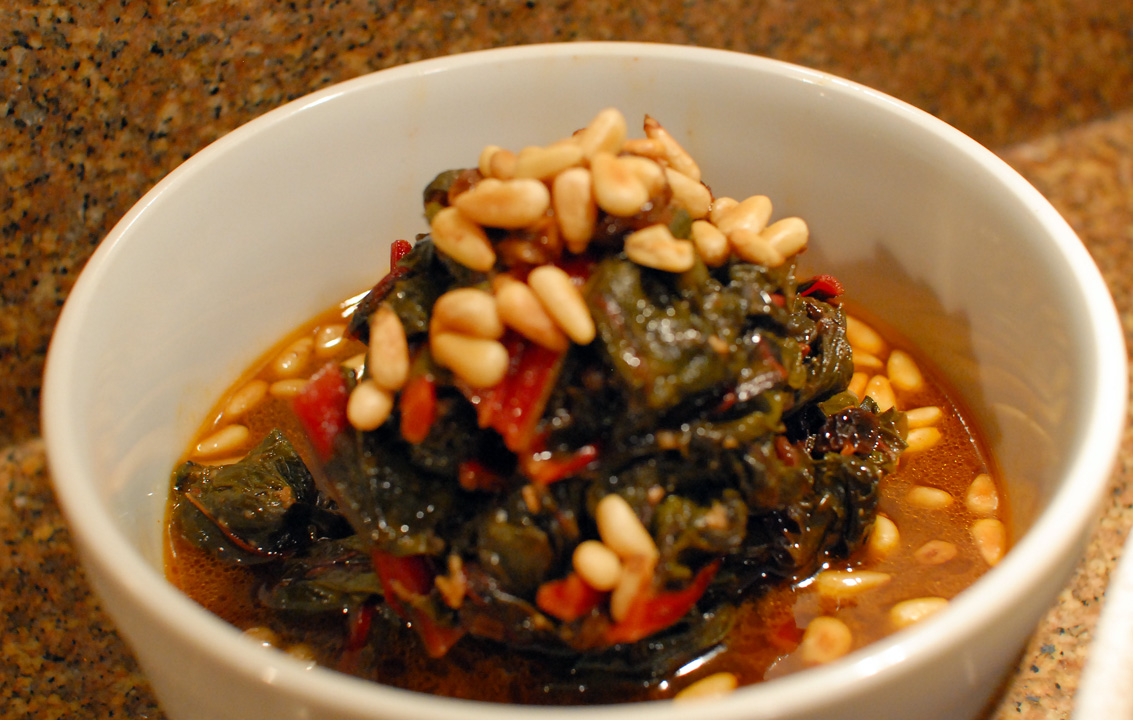
Chard is a nice accompaniment to the fish. Start by rinsing the chard and slicing it into strips that are about 1" wide. Saute with olive oil and garlic. Season with salt (I used smoked salt), paprika and a pinch of red pepper flakes. Add a splash of white wine and about 1/4 cup of water or broth along with a handful of raisins. Cover and let simmer for around 20 minutes. When the chard is done cooking, garnish it with toasted pine nuts.
Monday, January 11, 2010
Christmas Dinner
This year was the first time that I spent Christmas outside of Washington state. While my family has a tradition of getting together on Christmas Eve, this year, it was a bit quieter. Nothing was planned for Christmas Eve, so Abby and I decided to have her brother, Tony, and my brother-in-law, Mitch, and niece, Midori, over for dinner. We did a "surf-and-turf" menu with salt baked branzino and an herb-crusted rib roast served with brussels sprouts and bacon and roasted potatoes. None of this is really new. I've made each of these dishes before, so I won't go into detail about the preparation, but here are some pictures.

Above is the branzino, peaking out of the salt crust, and below is a picture of the finished product with some olive oil that we brought back from Tuscany.

Here's the rib roast.
 And hear are the brussels sprouts. Usually, I half or quarter the brussels sprouts and roast them, but this time around, I just shelled (peeled off the leaves) and sauteed them.
Sunday, July 12, 2009
Pan fried blue fish, chickpeas and spinach, and roasted asparagus
 It's been a busy month, so I haven't been posting much lately, but I have managed to cook a couple meals here and there. This dish uses the same chickpea and spinach recipe from my last post. The blue fish is a preparation that I've used a couple other times on this blog. Just season with salt and pepper, dredge in flour, and pan fry in olive oil. This gives the fish a nice crispy texture. It works well with any white fish. I decided to give blue fish a try since it was one of the cheaper fish at the market that day. Blue fish is a bit oilier than most fish, but it doesn't taste quite as fishy as mackerel. For the asparagus, just toss with a bit of olive oil and season with salt, pepper, and a dash of cayenne pepper. Roast at 350F until done (about 30 min).
Monday, April 20, 2009
Seared tuna, crispy rice cakes, and sesame spinach

INGREDIENTS
Tuna
- 2 servings tuna
- sesame seeds
- Baby spinach (enough for 2 servings)
- 1 carrot
- 1 Tbsp toasted sesame seeds
- 1 Tbsp soy sauce
- 1 tsp rice vinegar
- 1/2 tsp dashi
- 1 clove minced garlic
- 1.5 cups sushi rice
- 1-2 Tbsp rice vinegar
- Rice seasoning (Furikake), to taste
Julienne the carrot and cook until soft with a little oil. Add minced garlic and spinach. Cook until wilted. In a bowl, grind up the sesame seeds and mix in the soy sauce, vinegar, and dashi. Add this to the spinach and toss together.
Season the tuna with salt and pepper and coat one side with sesame seeds. Sear over high heat for one minute on each side.
(Pictured with a sauce made of miso, soy, dashi, ponzu, sake, and mirin)
Wednesday, April 15, 2009
Fish, Basque style

I think that making something "al Vasco" or "in the style of the Basque" just means that you use a lot of stewed peppers and onions. As this is a traditional dish, there are a million ways to make it. My version uses saffron, smoked paprika, thyme, and a little hot pepper to give the dish a really rich, warm taste. A lot of times, Basque style dishes include piquillo peppers. I didn't have any, but if you can get them, you might want to try adding them to the dish.
INGREDIENTS (for 2)
- 1 whole fish (branzino, trout, snapper, etc)
- 1 onion, cut in half and thinly sliced
- 1 red bell pepper
- 1 green bell pepper
- 1 tomato, seeded, and diced
- small potatos (enough for two servings)
- 4 cloves garlic
- 1/4 cup white wine
- 1/2 to 1 cup chicken or veggie broth/stock
- a pinch of red pepper flakes
- a pinch of saffron
- 2 tsp smoked paprika
- 1 tsp dried thyme or 2 tsp fresh thyme
- 1 T tomato paste
- parsley
- lemon
- salt
- pepper
- olive oil
Cut the bell peppers in half and core them. Toss the potatos with a little olive oil, salt, pepper, thyme and two cloves of minced garlic. Place the potatos and the bell peppers, separately, in the oven and roast for 30 minutes.
Slice up the onion and cook with olive oil over medium high heat. Once the onions begin to cook down, reduce the heat to medium or medium low and let cook, stirring occasionally for another 20 minutes or so. You don't want them to fry, so pay attention to the heat and keep it low. You want to really bring out the sweetness.
When the peppers and potatoes are done roasting, set the potatos aside and place the peppers in a paper bag or a bowl covered in plastic and let sit for a couple minutes. Once they are cool enough to handle, peel off the skins and slice into long thin strips. Add to the pan with the onions along with two cloves of minced garlic and the diced tomato and cook on medium heat for a couple minutes. Add the wine to this mixture and turn up the heat to reduce it. Add the red pepper flakes, paprika, and tomato paste and mix everything together. Add about 1/4 to 1/2 cup of stock along with the paprika and let simmer over low heat for about 5 minutes. Adjust seasoning with salt and pepper. You may also want to add a teaspoon of red wine vinegar.
While the stew is simmering, season the fish with salt and pepper and cut vertical slits along both sides of the fish. Once the stew is done, place it in a roasting pan or oven safe dish large enough to hold the fish and mix together with the potatos. Add more broth if this mixture looks too thick. Place the fish on top of the potatos, and cover with some of the pepper mixture. Roast at 400F for 30 minutes.
Carefully remove the fish to a cooking sheet. Again, be careful. It is really easy to break the fish here. Place the fish under the broiler for a couple minutes. Keep an eye on it. You want to crisp the skin, but it goes from crisp to burned really quickly. While the fish is broiling, mix 1 to 2 teaspoons chopped parsley into the peppers. Transfer everything to a serving dish (if you didn't just cook it in the serving dish), and place the fish back on top. Squeeze a bit of lemon over everything, garnish with some more parsley, and eat it while its hot.
Wednesday, February 18, 2009
Steamed Red Snapper with Chiles & Ginger, Braised Baby Bok Choy
This is one of my favorite recipes - it's so quick, easy, and healthy, with lots of delicious yet playful flavors. I love how the snapper delicately absorbs all the spicy chile and ginger juices without any effort on my part at all. In general, the recipes that I (Abby) put up here will require a lot less culinary acumen than Sam's dishes, so you can rely on my posts for our more remedial meals. ;)
 The ingredients aren't fancy:
Now, in a small skillet, heat the oil and saute the ginger, scallion, and chiles for about 30 seconds, until fragrant but not browned. Spoon all this over the fish, letting the oil seep into the scored parts. Then, all you have to do is place the plate of fish in your steamer, put the steamer over the boiling water in your wok, and cover it tightly. Steam the fish until it's cooked through, about 7-8 minutes. When you serve the fish over rice, make sure to transfer as much of the yummy juice as possible.
Sam and I like to add some cilantro (here added to the ginger/chile mix) and a squeeze of lime to the dish to top it off. You end up with a lovely mix of well-balanced, subtle flavors - with a bit of a spicy kick! You can check out the original recipe and other peoples' ideas at epicurious.com.
Braising the baby bok choy is also very simple. First, mix a teaspoon each of minced garlic and ginger. Then, saute it in a pan big enough to braise the bok choy in. Add enough water to fill the pan about a quarter of the way; a dash of soy sauce and mirin (about two teaspoons each); a quarter teaspon of dashi (which is a kind of japanese fish bullion that's good for soup bases like miso); and 2-3 tablespoons of sake. Leave it on medium-high heat and let the liquid reduce by about half. Reduce the heat to about medium and put the baby bok choy in (we used four small bunches for two people, cut in half). Cover the pan and cook for 6-8 minutes. You can use the braising liquid as a sauce after further reducing it - just remember to strain out the garlic and ginger before serving. That's it! Enjoy!
 The ingredients aren't fancy:
- 1 (1-pound) red snapper fillet with skin (3/4 inch thick)
- 1 tablespoon medium-dry Sherry
- 1/2 teaspoon salt
- 2 tablespoons vegetable oil
- 1 (3-inch) piece fresh ginger, peeled and cut into 1/16-inch-thick matchsticks (1 1/2 inches long)
- 1 scallion, cut lengthwise into 1 1/2-inch-long very thin strips (1/3 cup)
- 2 fresh serrano chiles, seeded and cut lengthwise into very thin strips
- 1/2 teaspoon Asian sesame oil
Now, in a small skillet, heat the oil and saute the ginger, scallion, and chiles for about 30 seconds, until fragrant but not browned. Spoon all this over the fish, letting the oil seep into the scored parts. Then, all you have to do is place the plate of fish in your steamer, put the steamer over the boiling water in your wok, and cover it tightly. Steam the fish until it's cooked through, about 7-8 minutes. When you serve the fish over rice, make sure to transfer as much of the yummy juice as possible.
Sam and I like to add some cilantro (here added to the ginger/chile mix) and a squeeze of lime to the dish to top it off. You end up with a lovely mix of well-balanced, subtle flavors - with a bit of a spicy kick! You can check out the original recipe and other peoples' ideas at epicurious.com.
Braising the baby bok choy is also very simple. First, mix a teaspoon each of minced garlic and ginger. Then, saute it in a pan big enough to braise the bok choy in. Add enough water to fill the pan about a quarter of the way; a dash of soy sauce and mirin (about two teaspoons each); a quarter teaspon of dashi (which is a kind of japanese fish bullion that's good for soup bases like miso); and 2-3 tablespoons of sake. Leave it on medium-high heat and let the liquid reduce by about half. Reduce the heat to about medium and put the baby bok choy in (we used four small bunches for two people, cut in half). Cover the pan and cook for 6-8 minutes. You can use the braising liquid as a sauce after further reducing it - just remember to strain out the garlic and ginger before serving. That's it! Enjoy!
Tuesday, November 11, 2008
Tuna burgers

I used the same recipe that I used to make the tuna meatballs here. If I make these again, I would use about half the amount of bread crumbs in the recipe. Serve on brioche with arugula that has been tossed in a very small amount of olive oil, lemon juice, and kosher salt.
Friday, October 17, 2008
Salt baked branzino
Here's yet another recipe from the Dave Pasternak cookbook. That makes three in a row. So far, they have all been good, but I think this is my favorite. It's easy, fun to make, and tastes really good.
Start with a whole fish. I used branzino, but any white fish will do. Just get whatever is fresh. Clean the fish, make sure it's scaled, clip all the fins, and stuff the cavity with lemon slices, a sprig of rosemary, some parsley stems (reserve the leaves for garnish), a clove of garlic, and a couple olives.
 For the salt crust, mix together salt in a ratio of about one egg white to a little over one cup of salt. This fish was a little over a pound, and I used 2 1/4 cups of salt and two egg whites. If you get a bigger fish, use 3 to 3 1/2 cups of salt.
Place a little of the salt mixture on a baking sheet cover this with a piece of parchment paper in the shape of the fish. This will allow you to remove the bottom side of the fish from the salt crust when you are done cooking.
 Cover the fish with the remaining salt mixture and bake at 400F for about 20 minutes.
 When the fish is done baking, crack the crust with the spoon and peel it away from the fish. Run your knife along the spine of the fish to separate the top fillet and remove carefully. After you plate the top fillet, you can just pull out the fish spine in one piece, leaving the bottom fillet in the salt crust. You can just lift up the bottom fillet by cutting loose the parchment paper and then sliding the fillet onto the plate. Garnish with some lemon and parsley. Since we had some egg yolks left over from the salt crust, we also made some lemon aioli to go with the fish.
 Serve the fish with whatever sides work for you. I made baked brown rice and a mixture of kale and collards with garlic, red pepper flakes, and bacon braised in chicken stock.

Start with a whole fish. I used branzino, but any white fish will do. Just get whatever is fresh. Clean the fish, make sure it's scaled, clip all the fins, and stuff the cavity with lemon slices, a sprig of rosemary, some parsley stems (reserve the leaves for garnish), a clove of garlic, and a couple olives.
 For the salt crust, mix together salt in a ratio of about one egg white to a little over one cup of salt. This fish was a little over a pound, and I used 2 1/4 cups of salt and two egg whites. If you get a bigger fish, use 3 to 3 1/2 cups of salt.
Place a little of the salt mixture on a baking sheet cover this with a piece of parchment paper in the shape of the fish. This will allow you to remove the bottom side of the fish from the salt crust when you are done cooking.
 Cover the fish with the remaining salt mixture and bake at 400F for about 20 minutes.
 When the fish is done baking, crack the crust with the spoon and peel it away from the fish. Run your knife along the spine of the fish to separate the top fillet and remove carefully. After you plate the top fillet, you can just pull out the fish spine in one piece, leaving the bottom fillet in the salt crust. You can just lift up the bottom fillet by cutting loose the parchment paper and then sliding the fillet onto the plate. Garnish with some lemon and parsley. Since we had some egg yolks left over from the salt crust, we also made some lemon aioli to go with the fish.
 Serve the fish with whatever sides work for you. I made baked brown rice and a mixture of kale and collards with garlic, red pepper flakes, and bacon braised in chicken stock.
Wednesday, October 15, 2008
Grilled swordfish
 Earlier in the summer Abby and I ate at this great restaurant in New York called Esca. We both love seafood and the food at the restaurant was really good, so we decided to get the cookbook. This week I've been going through the cookbook and making some of the recipes. This one is really simple. Its just a swordfish steak that's breaded and grilled. You can make breadcrumbs by running some stale bread through a food processor and seasoning with various herbs, or you can just buy some italian style bread crumbs from the store. Start by trimming the skin off of the sword fish steaks. Then season with salt and pepper and dredge in bread crumbs. If you have a charcoal grill, use that. If not, you can do what I did and use a grill pan. Cooking time depends on the thickness of the steak. I cooked it between 4-5 minutes on each side. The cookbook suggested serving this with a blood orange salad. I didn't have any blood oranges, and I usually stick with a protein/starch/veg. combo for my dinners, so I made brocolli with lemon, garlic, and red pepper, and a brown rice pilaf for the side dishes.
Saturday, August 2, 2008
Grilled trout and asparagus
 One of the sort of annoying things about planning for a wedding in a Catholic church is that you have to go through a series of meetings that, in the end, turn out to be completely useless. Last weekend, Abby had to fly up from DC for one of these useless meetings. Basically, we walked into the priests office, handed him some papers which were to be mailed to some central office to be stamped or something before being forwarded on to the church in Chicago where we are getting married. In retrospect, it was a huge waste of Abby's time, she really didn't need to be there, but at least we got to spend the weekend together. On one of here evenings in town, I made this nice little dinner for us. It's just a grilled whole trout with lemon jam and prosciutto wrapped asparagus with a mustard orange vinaigrette.
Monday, July 7, 2008
Esca
Esca was the one Batali-Bastianich restaurant that Abby and I had not eaten at yet. After a weekend of heavy eating, we were both in the mood for something a little lighter, so it was the perfect time to try out this Hell's Kitchen seafood restaurant. It was awesome. Esca is famous for popularizing crudo - basically, Italian-style sashimi - in the United States. In fact, the claim is that one of the restaurant's investors, Joe Bastianich, coined the term crudo for these raw fish preparations when he, Mario Batali, and Chef Dave Pasternak were traveling around Italy doing research before opening Esca. If you go here, you absolutely have to order the crudo tasting.
The crudo tasting comes in two flights of three. Each flight is served in a tri-sectioned plate on a bed of crushed ice. This keeps everything cool and makes for a great presentation. The first flight we received had a distinct Pacific Northwest feel, which, of course, I really liked. Going from top to bottom, we had an oyster - I don't know the origin, but it would make sense if it was from somewhere in the Puget Sound/Olympic Peninsula region - followed by geoduck with cherries, and wild salmon with pink peppercorns. These were all very good, but I liked the geoduck (pronounced gooey-duck, also referred to as giant clam) the most. Geoducks are native to Western Washington, and you'll see people digging them up almost anytime you go to a beach around the Puget sound. Cherries are another local fruit, and the combination evokes summer in the Pacific Northwest, which is about as good as it gets.

The next flight of crudo included seared yellowtail tuna
Kingfish with caviar (This was also awesome. I'm not sure which one I liked more, this or the geoduck), and razor clam with some hot chiles.
 After the crudo, we ordered an appetizer that was lightly scrambled eggs loaded with sweet corn and lump crab meat. This is something that I'll have to make at home. The sweetness of the corn and crab are ideal complements, and the still runny scrambled egg perfectly tied them together.
Next, we split an order of hand cut spaghetti with crab and sea urchin roe. Sea urchin in pasta is something I never would have thought of, but it worked really well. This was a very unique and surprisingly good dish.
 Finally, we had pan roasted red snapper with arugula, olives and hearts of palm. The snapper was perfectly cooked. A great dish.
 After trying all the Batali-Bastianich restaurants, this one ranks right near the top. Esca lacks the fame and formality of Babbo and Del Posto, but I think I actually enjoyed the food here more. More than anything, this probably has more to do with the fact that they were serving seafood than any other factor. With seafood, you can really tell when someone uses high quality ingredients and treats it just right. This clearly comes through at Esca. It was worth every penny.
The crudo tasting comes in two flights of three. Each flight is served in a tri-sectioned plate on a bed of crushed ice. This keeps everything cool and makes for a great presentation. The first flight we received had a distinct Pacific Northwest feel, which, of course, I really liked. Going from top to bottom, we had an oyster - I don't know the origin, but it would make sense if it was from somewhere in the Puget Sound/Olympic Peninsula region - followed by geoduck with cherries, and wild salmon with pink peppercorns. These were all very good, but I liked the geoduck (pronounced gooey-duck, also referred to as giant clam) the most. Geoducks are native to Western Washington, and you'll see people digging them up almost anytime you go to a beach around the Puget sound. Cherries are another local fruit, and the combination evokes summer in the Pacific Northwest, which is about as good as it gets.

The next flight of crudo included seared yellowtail tuna

Kingfish with caviar (This was also awesome. I'm not sure which one I liked more, this or the geoduck),
 and razor clam with some hot chiles.
 After the crudo, we ordered an appetizer that was lightly scrambled eggs loaded with sweet corn and lump crab meat. This is something that I'll have to make at home. The sweetness of the corn and crab are ideal complements, and the still runny scrambled egg perfectly tied them together.
Next, we split an order of hand cut spaghetti with crab and sea urchin roe. Sea urchin in pasta is something I never would have thought of, but it worked really well. This was a very unique and surprisingly good dish.
 Finally, we had pan roasted red snapper with arugula, olives and hearts of palm. The snapper was perfectly cooked. A great dish.
 After trying all the Batali-Bastianich restaurants, this one ranks right near the top. Esca lacks the fame and formality of Babbo and Del Posto, but I think I actually enjoyed the food here more. More than anything, this probably has more to do with the fact that they were serving seafood than any other factor. With seafood, you can really tell when someone uses high quality ingredients and treats it just right. This clearly comes through at Esca. It was worth every penny.
Saturday, July 5, 2008
Mary's Fish Camp
 Mary's Fish Camp is located on a quiet corner in Greenwich village, but it might was well be in a small town on the Cape. The restaurant is small, without being overly crowded, and a large metal counter sweeps through the center of the room, dividing the small dining area from the kitchen. The two walls facing the street are almost entirely glass, letting in a lot of light and lending to the coastal feel of the place. Vases with reeds sit on the window sills. These sort of remind me of the coastal vegetation you would see in a place like the Outer Banks. The interior walls were adorned with a painting of a sad looking fish and a chalkboard with the day's menu.
This restaurant is known for its unfussy preparation of really fresh ingredients. Its the kind of place where you can get a whole fish grilled with a little salt and pepper and a spritz of lemon juice. We ordered cockles with white beans and garlic for an appetizer, I had a spicy fried sardine sandwich, and Abby ordered the oyster po' boy. We both loved the appetizer. I thought my sandwich was great, but Abby was not impressed by the po' boy. It was good, but didn't measure up to our current standard, the Barking Carb in Boston. Even so, I would recommend this place. Prices were decent, the food was good, and the atmosphere is nice.
Saturday, June 14, 2008
Sushi Yasuda
 Last night, Abby and I went out to Sushi Yasuda with Alex and Jane. This is one of their favorite places, and I heard rave reviews from Abby after she went there last fall when she was in NYC interviewing with law firms. I had been looking forward to eating here, and I must say, this is hands down the best sushi I have ever had.
If you go, I would suggest sitting at the bar. Call ahead to see if you can get a place in front of Yasuda-san (pictured above). We just let him serve us what he thought was good, and since he knows more about seafood than I, or just about anyone else, can hope to know, that's really the best way to get a great dining experience. He's a really personable guy, and offers his views on sushi to you, explaining how important things like texture and temperature are to the taste of sushi.
Sushi, at its best, is very subtle. The decor at Sushi Yasuda reflects this idea. The heart of the restaurant is a long, blonde wood bar. The walls, ceilings, and floors are all the same, giving the restaurant a clean, understated look. When you sit at the bar, leaves, rather than plates, are your serving dishes. Each dinner gets a little pot of soy with a dipping bowl and plate, but these are unnecessary. You eat right off of the leaf as the chef serves you, and each piece of sushi is perfectly seasoned. Dipping it in soy would just ruin the delicate balance.
 I have always heard that the quality of the rice is what really distinguishes great sushi from good sushi. Getting high quality fish is about judgment and knowing the right purveyors. Yes, cutting the fish just so is a hard learned skill, but making great sushi rice is a craft that people spend years learning. At most places you go to, the rice sticks together and, when you eat the sushi, it more or less stays stuck together as you chew it. At Sushi Yasuda, the rice sticks together nicely, but each grain is distinct. When you put the sushi in your mouth, it gently falls apart, allowing you to appreciate the texture of each perfectly seasoned grain of rice.
 Temperature, timing, and attention to detail are all very important to making perfect sushi rice. You must rinse all of the starch from the rice and let it dry out thoroughly so that the grains don't stick together. You must cook the rice in just the right amount of water at just the right temperature for just the right amount of time. You must spread it out and fan it in a wooden bowl that will absorb some of the moisture. And, finally, when the rice has reached the proper temperature, you must season it with just the right amount of vinegar. At Sushi Yasuda, all of this is perfectly done. The amount of vinegar on the rice really livens up you taste buds and allows you to appreciate some of the more subtle cuts of fish.
While the rice is impressive, its just one half of what makes this place great. The selection is outstanding. All of the standards are hear...uni, unagi, squid, toro.
 But you don't just order, say, yellowtail, you can choose a specific type. Yasuda decided to give us a yellowtail tasting, offering four different varieties of yellowtail (below). For just about every type of fish on the menu, you have several options.
 You can also eat some things that you may not be able to find anywhere else. There were certainly a number of firsts for me. The scallops are a great example of his creativity. Normally, you just eat the adductor muscle of the scallop. Yasuda will serve this to you (top right), but you can also get the scallop tentacle, or gills that go around the fringe of the shell (bottom left), and the liver...I'm not sure if its actually a liver, but that's what he called it (bottom right). In the top left of the picture below, you see all the different parts of the scallops on Yasuda-san's cutting board. The color of the liver varies by gender (bright red or gray).
 Here are a couple more types of sushi....I can't remember all of them. The best one I had all night though, was the Peace Passage Oyster (from my home state of Washington) pictured in the top right below. I can't describe how good this was.
 Every last piece of sushi we had was amazing. Yasuda seasons each piece with wasabi, a squeeze of lemon juice, a brush of soy, and/or a sprinkle of sea salt. I had never thought of putting sea salt on sushi before... this idea is a Yasuda original....but it is really, really good. It adds just a little bit of crunch and saltiness that is completely unexpected. It is especially good with the uni.
 Yasudu isn't only about sushi, though. There are several interesting appetizers. Above, we have a bowl of different fish livers....another things that I had never had before. Do order this if you ever come here. It's delicious, just like everything else on the menu.
Friday, June 6, 2008
Sake & Miso Glazed Salmon with Lime & Scallion Sushi Rice
 This is a fairly straightforward dish. I had a salad on the side, but if you want a well rounded plate with the typical protein/starch/veg trio, baby bok choy would make a great addition. The dish is finished off with a soy/ginger/ricewine vinegar reduction.
Sake & Miso Glazed Salmon (2 servings)
-Salmon (1/2 lb)
-Sake (1/4 cup)
-Miso paste (1/4 cup)
-Mirin (1 Tbsp)
-Soy (1 Tbsp)
-Ginger (1/2" root, grated)
-Sugar (2 Tbsp)
Combine all of the ingredients and marinate the salmon for a couple hours or overnight. Broil for about 10 minutes. Keep an eye on the salmon as it cooks. The glaze has sugar in it, so it will burn.
For the rice, use a short grain sushi rice. When you're using sushi rice, you want to thoroughly rinse the rise and let it sit for at least a half hour. This process gets ride of a lot of the starch on the surface and is the key to getting good sushi rice. Mix together the juice from 1/2 of a lime (for one cup of rice) and 1 tsp sugar. Let the rice cool slightly then mix the juice and 1-2 finely chopped scallions with the rice.
Thursday, May 29, 2008
Roasted black bass and fingerling potato stacks
Abby is spending the summer in NYC doing to whole corporate law thing. I've hear mixed opinions about this type of work. Some people really like it; some people tolerate it because they have law school loans to pay off; and some people think it's the most horrible work imaginable. Say what you will about corporate law, but one thing is undeniable. The food is good. Last week, one of the partners at the law firm invited Abby out to lunch and, being a workaholic, said that he didn't really go out to lunch much. So, being a rare occasion, he wanted to go someplace really nice, like Jean Georges. This, by the way, is one of the few restaurants that has 4 New York Times stars. When Abby and I were researching restaurants - for now, I'll just have to live vicariously through her high-end eating experiences - we discovered two things of interest: 1) lunch at Masa costs $400 per person, and 2) Jean-Georges Vongerichten has a blog. The first piece of info was interesting insofar as it was a shockingly high price to pay for lunch. I wonder if this is the most expensive lunch in the world? The second piece of information will actually be useful because this guy is an amazing chef and he occasionally posts recipes, like this one. It looked good, so I decided to give it a try.
 As with a lot of home cooking, you don't need to do a lot of technical work to make the dish a success. There are no reductions or emulsions here, just a few ingredients thrown in a pan. Probably the hardest thing to do is slicing the lemons really thin. If you have good knife skills, this isn't a problem. If not, use a mandoline.
Here is the finished dish
 I paired the fish with a stack of fingerling potatoes and some lemon-garlic aioli. This dish was inspired by the patatas bravas they make at Casa Mono.
To make the aioli, just whisk together an egg yolk, lemon zest, and two cloves of garlic. You want to mince the garlic and then crush it to a paste by repeatedly dragging the edge of your knife over the mound of minced garlic. Add a pinch of salt and pepper, and then begin whisking in olive oil. Add the oil very slowly. The taste from the olive oil can be overpowering, so you may want to cut it with a flavorless oil like canola. When the mixture gets too thick, thin it out with lemon juice. You want to add about 1/2 cup of oil per egg yolk.
For the potatoes, begin by boiling the fingerling potatoes in a pot of heavily salted water until they are done. They are done when a knife pokes through them with little resistance. Let the potatoes cool and then slice them in half lengthwise. Finish them off on the stove top over high heat with some olive oil, garlic, herbs (I just used thyme), salt and pepper. Spoon out a base of aioli on which to stack the potatoes. Top with another dollop of the aioli.
 As with a lot of home cooking, you don't need to do a lot of technical work to make the dish a success. There are no reductions or emulsions here, just a few ingredients thrown in a pan. Probably the hardest thing to do is slicing the lemons really thin. If you have good knife skills, this isn't a problem. If not, use a mandoline.
Here is the finished dish
 I paired the fish with a stack of fingerling potatoes and some lemon-garlic aioli. This dish was inspired by the patatas bravas they make at Casa Mono.
To make the aioli, just whisk together an egg yolk, lemon zest, and two cloves of garlic. You want to mince the garlic and then crush it to a paste by repeatedly dragging the edge of your knife over the mound of minced garlic. Add a pinch of salt and pepper, and then begin whisking in olive oil. Add the oil very slowly. The taste from the olive oil can be overpowering, so you may want to cut it with a flavorless oil like canola. When the mixture gets too thick, thin it out with lemon juice. You want to add about 1/2 cup of oil per egg yolk.
For the potatoes, begin by boiling the fingerling potatoes in a pot of heavily salted water until they are done. They are done when a knife pokes through them with little resistance. Let the potatoes cool and then slice them in half lengthwise. Finish them off on the stove top over high heat with some olive oil, garlic, herbs (I just used thyme), salt and pepper. Spoon out a base of aioli on which to stack the potatoes. Top with another dollop of the aioli.
Saturday, April 5, 2008
Miso-glazed perch in dashi soy broth with vegetables

This is a rare attempt at health cooking. We have broiled miso glazed perch over some baby bok choy that was braised in a dashi soy broth and soba noodles with carrots, red bell peppers, snow peas and ginger. Since everything was simmered or broiled, I didn't need to use a drop of oil for this dish.
Monday, March 31, 2008
Wedding tasting, round 2
Our first trip to the Food for Thought Kitchens was tasty, but none of the dishes they came up with were quite what we were looking for, so last week when Abby and I were in Chicago for a whirlwind week of wedding planing, we went back to the caterer's for another tasting. We had already picked out our salads and appetizers, so it was just main courses this time. Of the four we tried, three were fantastic candidates. Now we just have to narrow it down to the one or two dishes that we want to serve at the wedding, which will be hard since they were all so good.
First, we tried a seafood dish: Sweet Sake Roasted Wild Striped Bass with Dashi Soaked Soba Noodles, Wok Fried Vegetables, Tempura Fried Shiitake Mushrooms, and a Soy Miso Broth. This one is probably a keeper since (aside from tasting really good) we know so many pescaterians or vegaquariums or whatever you call people that make seafood the one exception to an otherwise vegetarian diet.
 The next two dishes out were both chicken. As I've blogged about before, ordering the chicken dish is a good way to see how good a kitchen is. You can go to a lot of reputable restaurants and get a somewhat dry pan roasted chicken. This place, it turns out, does chicken better than most restaurants I have been to. The truffled chicken breast is outstanding.
Here's dish one:
1) Frenched Chicken Breast with Summer Truffle with Garlic-Braised Baby Bok Choy, Black Beauty Eggplant, Tri-Color Carrot, Basil Glace
 2) Pan-Roasted Chicken Breast Grilled Fingerling Potato, Asparagus, Marconi Pepper Chutney, Enoki Mushrooms, Sherry-Ginger "Reduction"
 Of the two chicken dishes, the first one was a better match with the flavors we were looking for.
Finally, we tried another take on braised shortrib, a dish we had tried at the initial tasting. This dish was a bit on the heavy side for a summer meal, but it was damn good and may be hard to pass up on.
Star Anise Braised Beef Short Rib with Scallion Potato Puree, Cippolini Onion, Sugar Snap Peas, Shitake Mushrooms.


First, we tried a seafood dish: Sweet Sake Roasted Wild Striped Bass with Dashi Soaked Soba Noodles, Wok Fried Vegetables, Tempura Fried Shiitake Mushrooms, and a Soy Miso Broth. This one is probably a keeper since (aside from tasting really good) we know so many pescaterians or vegaquariums or whatever you call people that make seafood the one exception to an otherwise vegetarian diet.
 The next two dishes out were both chicken. As I've blogged about before, ordering the chicken dish is a good way to see how good a kitchen is. You can go to a lot of reputable restaurants and get a somewhat dry pan roasted chicken. This place, it turns out, does chicken better than most restaurants I have been to. The truffled chicken breast is outstanding.
Here's dish one:
1) Frenched Chicken Breast with Summer Truffle with Garlic-Braised Baby Bok Choy, Black Beauty Eggplant, Tri-Color Carrot, Basil Glace
 2) Pan-Roasted Chicken Breast Grilled Fingerling Potato, Asparagus, Marconi Pepper Chutney, Enoki Mushrooms, Sherry-Ginger "Reduction"
  Of the two chicken dishes, the first one was a better match with the flavors we were looking for.
Finally, we tried another take on braised shortrib, a dish we had tried at the initial tasting. This dish was a bit on the heavy side for a summer meal, but it was damn good and may be hard to pass up on.
Star Anise Braised Beef Short Rib with Scallion Potato Puree, Cippolini Onion, Sugar Snap Peas, Shitake Mushrooms.


Thursday, October 18, 2007
Wedding planning
In early September, Abby and I went to Chicago to go to a friends wedding and get some of our own wedding planning underway. We spent a day running around the city to meet with the photographer, check out a church, a bakery, the venue, and, finally, at the end of the day we went to the caterer's main kitchen for a tasting.
 We tried out three salads. Here are two of them. I forgot to take a picture of the third one. We also tried a number of hors d'oeuvres, some good, some not so great. We think we'll go with the last salad pictured. Everyone liked the fresh berries in it, and the flower petals were a nice touch.

 The salads were followed by three sample main courses. Fish, chicken, and beef. Surprisingly, the chicken was the best of the three. The fact that they used truffle butter in the chicken probably didn't hurt. I also liked the beef dish, the brussels sprouts in particular, but everyone else seemed to think that a lot of guests would not be as excited about them.


We finished off with a desert plate, which probably won't make an appearance at the wedding.
 I don't think any of the dishes will show up on the wedding day menu in their current form, but that gives us a good excuse to go back for another tasting.
 We tried out three salads. Here are two of them. I forgot to take a picture of the third one. We also tried a number of hors d'oeuvres, some good, some not so great. We think we'll go with the last salad pictured. Everyone liked the fresh berries in it, and the flower petals were a nice touch.
 The salads were followed by three sample main courses. Fish, chicken, and beef. Surprisingly, the chicken was the best of the three. The fact that they used truffle butter in the chicken probably didn't hurt. I also liked the beef dish, the brussels sprouts in particular, but everyone else seemed to think that a lot of guests would not be as excited about them.


We finished off with a desert plate, which probably won't make an appearance at the wedding.
 I don't think any of the dishes will show up on the wedding day menu in their current form, but that gives us a good excuse to go back for another tasting.
Subscribe to:
Posts (Atom)

 Posts
Posts


