Showing posts with label seafood. Show all posts

Monday, September 5, 2011

Hurricane Dinner Party

It's been more than six months since my last entry here....I've been busy, and, when I have been cooking, I've mostly been repeating dishes that I've already posted here and/or forgetting to take pictures. Last week, the confluence of friends from grad school coming into town (some moving here, others passing through for a conference) and a hurricane provided the perfect excuse to stay indoors, cook lots of food, drink lots of good wine while we waited out the weather. The theme for this dinner party was Asian, or, more specifically, the Momofuku cookbook, which I have been reading a lot of but not cooking a lot of. Two of the four courses for this dinner were directly from the cookbook, one borrowed an ingredient from the cookbook to jazz up an old favorite, and the fourth dish involved me just cutting up some super fresh fish from Black Salt.

We started out the meal with a trio of raw fish. Here's an action shot of the dishes being prepared.
Here's a finished plate.
In the foreground are slices of ivory salmon (which I had never heard of before I walked into Black Salt looking for fish earlier that day) and king salmon. Being late August, king salmon are at their peak. I love the bold striations on this salmon. The ivory salmon was soaked in lime juice for a couple of seconds, then topped with a Spanish olive oil, smoked salt, and a lime zest. The king salmon was simply topped with some nice grassy tuscan olive oil and a bit of cracked pink peppercorns. The third dish, in the little bowls in the background, was an Ahi tuna poke. To make the poke, I cut the ahi into cubes (about 1 cm) and let it marinate in a mixture of soy sauce, sesame oil, and scallions with a dash of rice wine vinegar, and pinch of red pepper flakes. Just before serving, I tossed in some sesame seeds and then topped the poke with some strips of toasted nori.

Next came the veggie course: pan roasted asparagus and grilled king oyster mushrooms with miso butter and slow poached eggs.
Although I don't really like mushrooms, I really like the look of this dish. For some reason, the combination of the mushrooms and asparagus piled on top of the miso butter with the whole eggs has a really rustic, "farm to table" look to it. To make the slow poached eggs, you need to let the eggs sit in 140F water for around 45 minutes. If you were plating these individually (as they do in the Momofuku cookbook), you would spread out a bit of miso butter, artfully arrange the asparagus, and then place the poached egg across the top of the asparagus. In this family style preparation, the eggs would have all slid off to the side of the plate and, when serving, the yolks surely would have broken on the serving plate, leaving all of the yolky goodness behind. When served this way, everyone gets to crack their own egg, which is much cleaner and, besides, its fun.
The third course was miso and sake marinated sea bass with scallions, sunchoke puree, and bacon dashi. Sea bass is something I've posted before. It's a great dish for a dinner party since all the flavor comes from letting it marinate for a long time (in this case, 48 hours), but it is really quick to cook. While we were eating the second course, I just stuck the fish under the broiler for about 10 minutes. You will need to flip the fish about half way through so it cooks evenly and the sugar in the marinade doesn't burn too much. The bacon dashi is a pretty straight forward (and brilliant) recipe from the Momofuku cookbook. Just steep some konbu in water for a few minutes, remove, then simmer some smokey bacon in the broth for about 30 minutes, chill, skim off the fat, and reheat before service. For the sunchoke puree, just peel the sunchokes, boil until tender, and puree in a food processor with butter. Season with salt and pepper. If you wanted to make this really rich, you could simmer the sunchokes in cream.
For the last course, we had steamed Chinese buns that Abby had made earlier in the day (see the freshly formed buns, waiting for the steamer below) with roasted pork belly, quick pickles, and other accoutrements.
Like the fish, the pork belly is a dish where all of the work is done ahead of time. I cured the pork belly in salt, sugar, pepper, and five spice powder for 24 hours, then roasted it at 450F for 45 minutes followed by another 3 hours at 250. Then, I chilled the pork belly over night, sliced it, and reheated it just before serving. Here's a finished pork belly bun.

Tuesday, June 29, 2010

Monkfish with grilled asparagus and romesco

Here is yet another dish from the Ad Hoc at Home cookbook. The recipe calls for baby leeks, but since those are hard to find, I went with asparagus instead. I used the leftover romesco sauce from the previous blog post, and then I pan roasted the monkfish with rosemary, thyme, and garlic. I bought the monkfish at Isaacson and Stein, where they just sell whole monkfish tails, and they leave it to the customer to actually fabricate the fish. Monkfish are really ugly, prehistoric looking creatures, and a giant fish doesn't really yield that much edible meat. Monkfish are almost all head and jaws connected to a tail that propels said head and jaws towards its pray. With most fish, you can fillet them fairly easily with a couple quick swipes of the knife down each side of the spine. Monkfish are not so simple. I have seen monkfish fabrication as a challenge on Top Chef before, but I had never actually taken apart a monk fish myself.

To prepare the monkfish, remove it from the fridge about 30 minutes before cooking to let it get to room temperature. Season with salt and pepper, and then sear over high heat in a pan with canola oil for a few minutes (after about 3 minutes check to see if a crust has formed). Add 2 tablespoons of butter turn the heat to medium (you don't want to burn the butter) and, once melted, tilt the pan and baste the monkfish as it is frying. Once one side is nicely browned, turn the monk fish, add a couple sprigs of rosemary, thyme, and garlic along with another tablespoon of butter. Continue to fry/baste for another 3 to 5 minutes until the fish is cooked through and a golden crust has formed on the other side of the fish.

Thursday, May 20, 2010

Black spaghetti with shrimp, soppresata, and green chile pesto

You can find the recipe for this dish here. It's one of the signature dishes at Babbo. Ideally, I would have used the tastier, smaller rock shrimp that the recipe calls for, but they didn't have any at the fish market. You can get the squid ink pasta here. As I've mentioned in previous posts, they (Maestri Pastai) make the best pasta out there.

Wednesday, May 19, 2010

Pea, fava bean, and shrimp salad with mint, chives, parsley, and lemon.

This is more or less a reproduction of one of the dishes we had at the Purple Pig a couple weeks ago...you know a restaurant is good when it inspires you to go home and recreate everything you ordered.

INGREDIENTS:
~ 20 Shrimp, peeled and deveined
~ 2 cups of peas (fresh if possible)
~1 cup of fava beans
2 Tbsp Mint, chiffonade
1 T Parsley, finely chopped
1 T Chives, finely chopped
Zest and juice from 2 lemons
Olive oil.
Salt

Steam the shrimp for about 3 to 4 minutes. Shell the fava beans and steam for about 2 to 3 minutes. After steaming the fava beans, they will be much easier to remove from their skins and perfectly cooked for this recipe. If you are using frozen peas, just thaw them out in some water. If you are able to get your hands on fresh, English peas, boil them in salted water for a little over a minute and then cool them down in an ice bath. You still want the peas to have a bit of a bite to them. Toss together all of the ingredients and season to taste with salt. This should be a very acidic dish, so add more lemon if necessary. The lemon will cause all the nice green stuff to discolor over time, so you don't want to assemble this more than an hour or two before serving. You should serve it cold, so give it around 30 minutes in the fridge before serving.

Sunday, May 2, 2010

Spring menu

Earlier this week, we went to the Purple Pig (see a friend's review here), where we had a truly fantastic, seasonal meal full of ingredients like asparagus, peas, ramps, rock shrimp, and fava beans all dowsed in a healthy dose of lemon. That put me in the mode to do a few spring dishes, so, yesterday, we had a couple people over for a big spring dinner. Here's the menu: cannellini bean salad with grilled tuna and endives, a shaved asparagus and pecorino salad, confit pork belly with fennel pollen and spicy piquillo aioli, seared scallops with meuniere sauce, langoustines a la plancha with anchovy and caper butter, minted pea ravioli with shaved parmigiano-reggiano, mint, chives, chive blossoms, and truffle oil, heirloom potatoes roasted in duck fat with garlic confit and thyme, and lake trout, roasted whole with lemon, served with classic aioli and a roasted red pepper, piquillo, and miso sauce. We served it with the following wines, which I thought were all pretty good: 2007 Cellar Can Blau Montsant, 2007 Pio Cesare Cortese di Gavi, and 2007 Domaine de la Villaudiere Sancerre. Yes, it was a lot of food.

We didn't get a picture of the cannellini bean salad, but you can get the recipe from an earlier post.
We got the asparagus salad idea from our meal at the Purple Pig. It's similar to a brussels sprout salad that we make a lot.
INGREDIENTS
1 bunch asparagus
1-2 lemons
Extra virgin olive oil (preferably Tuscan or something with nice grassy notes to it)
Pecorino-romano
Salt, pepper

Break off the ends of the asparagus stalks, slice thin, on a bias. To make slicing easier, keep the asparagus bound by the rubber band that it comes with. Since this is a raw preparation, you want to cut the asparagus as thin as possible so it won't be too tough. Use a mandoline if you have one.

Add the zest and juice from one to two lemons. Add about 2-3 tablespoons of olive oil along with about 1/4 to 1/2 cup of grated cheese. Season with salt and pepper. Add more olive oil and lemon juice if necessary. The amount of lemon to add depends on your preferences. This should have a very "bright" taste to it, so the juice from 1.5 to 2 lemons is probably best.

We got bits of pork belly from a butchering demonstration at Mado, which I'll post more on latter. The recipe comes from Ad-Hoc At Home, so I won't repeat it here. I served it with a spicy aioli that was left over from a yet to be posted meal.

The scallops, along with the langoustines, were impulse buys from our trip to Isaacson and Stein. They had big tubs full of big, fresh scallops and lovely, lovely langoustines. The scallops were given a quick salt water brine, then dried off in the fridge for a couple hours. I seared them over medium high heat in clarified butter. To make the meuniere sauce, simply add lemon juice, capers, and parsley to the butter and swirl around for a minute or so to emulsify the mixture a bit.The langoustines were definitely the highlight of the meal. We first had this dish at Prune, and we've bean wanting it again ever since.
INGREDIENTS
langoustines
butter
anchovies
capers
lemon
salt

Brine the langoustines in a salt water solution (2 cups water to 5 oz. salt) for 10 to 15 minutes and pat dry with paper toils.

Get a cast iron griddle piping hot. It may take up to 5 minutes. Turn your fan on, open the doors and windows. This will create a lot of smoke. Spread clarified butter over the cooking surface and immediately add the langoustines. If the smoke gets too out of control, turn the heat down a bit. Cook the shrimp for about 6 to 7 minutes on each side. While the langoustines are cooking, melt a stick of butter in a small sauce pan. Add about 10 anchovy fillets and crush in the pan with the melted butter until they break up into really small pieces. Add capers.

When the langoustines are done, place them on a serving plate, season with sea salt, pour half the butter over the top, and reserve the other half in a separate bowl for dipping. Serve lemon wedges on the side. Try to contain yourself.

We didn't get a picture of the ravioli. It is similar to this dish, but I added ricotta to the stuffing and took advantage of the community garden that has a bunch of blossoming chives right now.
For the fish, I just used this recipe, but I increased the cooking time to 50 minutes since this was one huge fish. It probably could have used another 10 minutes in the oven. I served it with a classic aioli and a red pepper sauce (you can find the recipe here). I really love this sauce. It goes great with grilled and roasted vegetables and meats and will probably be a staple of my summer cooking.

Thursday, April 15, 2010

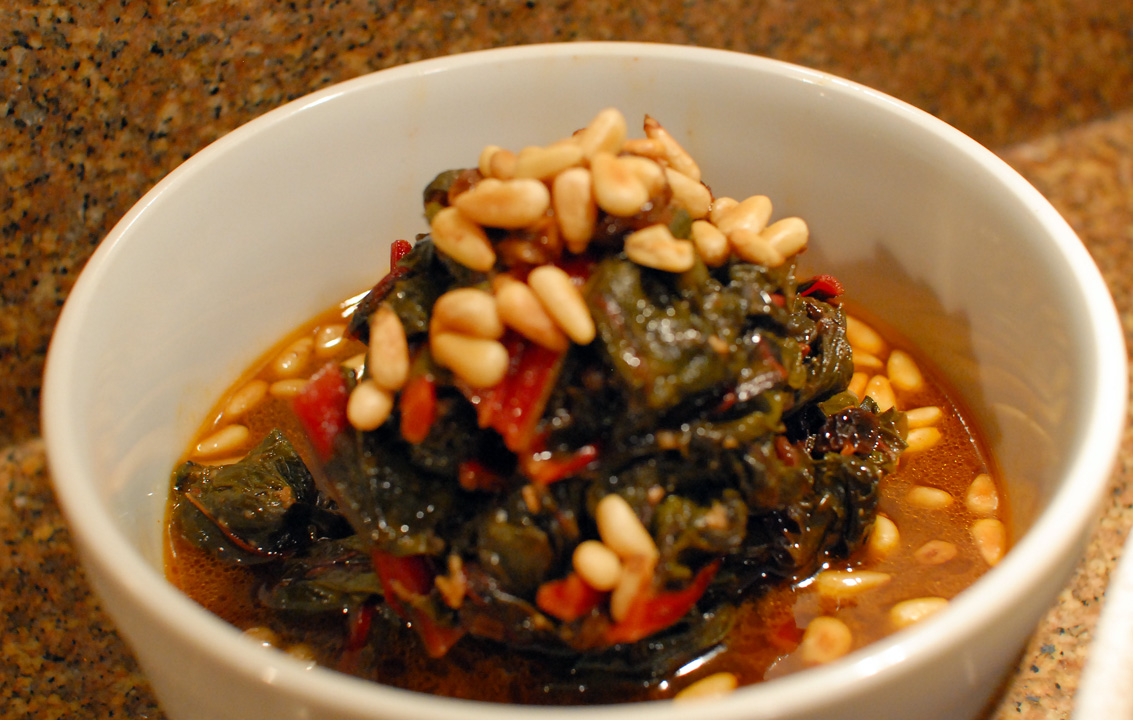
Roasted branzino with lemon and capers, Braised chard with pine nuts and raisins

Few things are easier to make than a roasted fish. For this dish, I just seasoned the fish with salt and pepper, fill the cavity with lemon slices, rosemary, basil, and thyme, place the fish on top of slices of lemon and place another layer of thinly sliced lemon on top, cover with 1/4 cup olive oil, and add another 1/4 to 1/3 cup of white wine to the roasting pan along with some capers and olives, if you have them. Roast the fish at 400F for 20 to 30 minutes, and use the reserved liquid from the roasting pan as a sauce.

Chard is a nice accompaniment to the fish. Start by rinsing the chard and slicing it into strips that are about 1" wide. Saute with olive oil and garlic. Season with salt (I used smoked salt), paprika and a pinch of red pepper flakes. Add a splash of white wine and about 1/4 cup of water or broth along with a handful of raisins. Cover and let simmer for around 20 minutes. When the chard is done cooking, garnish it with toasted pine nuts.

Tuesday, April 13, 2010

Ceviche

The last couple of times I've been to Isaacson & Stein, they've had some nice looking corvina, a white fish that is commonly used to make ceviche. So, of course, Abby and I had to try our hand. This picture comes from our second batch of ceviche. The first time around, we just used the corvina, but we added shrimp and scallops to this batch.
RECIPE:
-1/2 lb corvina
-1/4 lb shrimp
-1/4 lb scallops
-1 serrano pepper (minced)
-6 limes
-1 lemon
-2 shallots
-1/8 cup chopped cilantro
-1 Tbsp basil (chiffonade)
-2 shinly sliced radishes
-1 green onion, thinly sliced
-salt, pepper
-olive oil

Cut the fish, shrimp, and scallops in cubes (about 1cm). Season with a pinch of salt and pepper. Cut the shallots in half, lengthwise, and then cut into long strips. Toss together the seafood, shallots, serrano pepper, radishes, and green onion. Reserve the zest from one lime and one lemon, squeeze the juice from the lemons and limes and add to the fish mixture along with the zest. Mix together, cover, and refrigerate for 3 hours. Make sure there is enough liquid to cover most of the fish, and check in on the ceviche occasionally to give it a stir. Keep tasting the fish until it has "cooked" to your liking. When it is ready, stir in the basil and cilantro. Season with more salt if necessary, and garnish with olive oil. Serve with corn chips to add some texture.

Monday, July 13, 2009

Crab and corn risotto (and how to fix an overseasoned risotto)

Crab and corn are a great combination. Abby and I first had a crab and corn dish at Esca in NYC, and, since then, I've made crab and corn pasta. Since we are moving in a couple weeks, we're in the process of clearing out the freezer, and I had some lobster stock that I didn't want to go to waste, I decided to put it to use as a base for a risotto and figured that the crab corn combo would do well for this dish. Here's the recipe:

INGREDIENTS
-1.5 cups Arborio rice
-2 quarts stock
-1/4-1/2 cup white wine
-2 shallots, minced
-2 cloves garlics, minced
-3 T butter
-1/4-1/2 cup grated Parmessan
-container crab meat (can't remember the size, it's whatever they sell at Whole Foods)
-1 cup sweet corn

Melt 2Tbsp butter over medium heat, cook the shallots and garlic until the shallots become soft and translucent.

Add the rice and stir to coat with butter for about 1 minute. Add the white wine and let reduce. Meanwhile, the stock should be simmering, so it is hot when you add it to the risotto.

Add the stock one ladel full at a time, stirring constantly, until done. When the risotto is all dente, stir in the remaining tablespoon of butter, the cheese, crab, and corn. Add stock to adjust consistency and season to taste with salt and pepper.

Usually stock isn't that salty, but in this case, it was, which proved to be a problem. It's not a bad idea to thin out stock with water just to keep the flavor from overpowering everything else (the flavor gets really concentrated in the rice), and in this case the dish was just too salty. To fix it, I just cooked up another 1/2 cup of arborio rice using water and absolutely no seasoning. I diluted the overly salty risotto with this and the result was pretty good. This should work with any over seasoning problems you should run into with risotto.

Sunday, July 12, 2009

Pan fried blue fish, chickpeas and spinach, and roasted asparagus

It's been a busy month, so I haven't been posting much lately, but I have managed to cook a couple meals here and there. This dish uses the same chickpea and spinach recipe from my last post. The blue fish is a preparation that I've used a couple other times on this blog. Just season with salt and pepper, dredge in flour, and pan fry in olive oil. This gives the fish a nice crispy texture. It works well with any white fish. I decided to give blue fish a try since it was one of the cheaper fish at the market that day. Blue fish is a bit oilier than most fish, but it doesn't taste quite as fishy as mackerel. For the asparagus, just toss with a bit of olive oil and season with salt, pepper, and a dash of cayenne pepper. Roast at 350F until done (about 30 min).

Sunday, June 14, 2009

Crispy Red Snapper, Stir Fried Vegetables, Green Tea Sushi Rice with Furagake

Fish:
Season with salt and pepper, dredge in flour, and cook over medium high heat in a non-stick pan with a bit of canola oil.

Vegetables:
Julien carrots and bell peppers. Mince one clove garlic and 1 teaspoon ginger. Stir fry in a wok over high heat for one minute. Add snow peas. Season with soy sauce and a bit of rice wine vinegar.

Rice:
Rinse sushi rice, add a tea ball with green tea, cook rice. When done, season with salt and pepper.

Friday, May 15, 2009

Shrimp & grits with collard greens

I haven't cooked a ton of Southern food in the past, but we had a bunch of collard greens from this weeks produce delivery, so I figured it would go well with this dish. A basic version of shrimp and grits is really easy to make...just cook the grits and add shrimp, but it's really good to dress it up with a little Cajun style stew. A lot of recipes use milk as the basis for the grits, but I choose to make a homemade shrimp stock using a bunch of shells from some Main shrimp that had been sitting in the freezer. Here's my take on this Southern classic.

INGREDIENTS:
  • Shrimp (about 4-6 per serving)
  • 1/2 red bell pepper (small dice)
  • 1 stalk celery (small dice)
  • 1/2 vidalia onion (small dice)
  • tasso (small dice)
  • 2-3 Tbsp flour
  • 2-3 Tbsp butter, + 2 Tbsp butter
  • 1/4 cup whole milk
  • 5-6 cups shrimp stock
  • 1 cup course ground corn meal
  • salt
  • pepper
  • Cajun seasoning
  • 2 cloves garlic, sliced
  • red pepper flakes
  • lemon
  • 1 bunch collards, sliced into 1/2 to 1" strips
Directions for the stew
Melt the butter in a pan over medium high heat. Once melted, add an equal measure of flower and stir together. Keep cooking and stirring the roux until it becomes a very dark brown. Add the diced trinity (bell pepper, onion, and celery) and cook until soft (about 3 minutes). Add the diced tasso (Dice an amount that is equal to the amount of bell pepper, celery, OR onions. You want all four of the ingredients to be in equal parts). Cook for another 2 minutes. Season with cajun seasoning (~1/2 tsp), salt and pepper. Add the milk a little bit at a time, stirring constantly. Then add about 1 cup of the shrimp stock. Let simmer.

Directions for grits
Bring about 4 cups shrimp stock to a boil. Add 1 cup corn meal and stir. Keep stirring as the corn meal absorbs the liquid and the mixture begins to thicken. Season with salt and pepper. Once it is at a porridge like consistency, add 2 T butter and 1/2 -1 cup grated cheddar cheese. Season to taste with salt and pepper.

Directions for collards
Cut out think stems and slice collards across into 1/2" to 1" strips. Heat up 1 T olive oil in a pan and add 2 cloves minced garlic and a dash of red pepper flakes. When the garlic begins to brown, add the collards. After 1 to 2 minutes, add about 1/2 cup water or chicken stock. Turn the heat down to medium, cover, and let simmer. Before serving, toss a bit of lemon juice or cider vinegar in with the greens.

Directions for shrimp
Heat up 1 T butter over high heat. Add 1 clove on minced garlic and cook for 30 seconds. If the butter begins to brown, turn the heat down a little. Add the peeled, deveined shrimp and saute for about 1 minute. Add the shrimp to the stew.

To serve, add a few spoonfuls of grits to a bowl or plate and top with the shrimp/stew mixture and collards. Serve with lemon slices.

Monday, April 20, 2009

Seared tuna, crispy rice cakes, and sesame spinach


INGREDIENTS
Tuna
  • 2 servings tuna
  • sesame seeds
Spinach
  • Baby spinach (enough for 2 servings)
  • 1 carrot
  • 1 Tbsp toasted sesame seeds
  • 1 Tbsp soy sauce
  • 1 tsp rice vinegar
  • 1/2 tsp dashi
  • 1 clove minced garlic
Rice cakes
  • 1.5 cups sushi rice
  • 1-2 Tbsp rice vinegar
  • Rice seasoning (Furikake), to taste
Cook the rice. Let it cool to and add vinegar as if you are making sushi rice. Mix in furikake to taste. Form the rice into patties and cook until crispy and golden brown on each side.

Julienne the carrot and cook until soft with a little oil. Add minced garlic and spinach. Cook until wilted. In a bowl, grind up the sesame seeds and mix in the soy sauce, vinegar, and dashi. Add this to the spinach and toss together.

Season the tuna with salt and pepper and coat one side with sesame seeds. Sear over high heat for one minute on each side.

(Pictured with a sauce made of miso, soy, dashi, ponzu, sake, and mirin)

Sunday, April 5, 2009

Oyster Po' boy @ the Barking Crab

The Barking Crab's oyster po' boy...calling out to you...

Last month, Sharlene, Sam, and I biked over to Southie to catch Boston's St. Patrick's day parade for the first time. It was a crazy mix of bagpipe n' drum contingents from every imaginable police precinct in new england, drunken pub-hoppers, fully-garbed colonial minutemen, politicians boasting names like Flaherty and O'Whatever, imposing military vehicles, and, uh, Star Wars characters.

Afterwards, we walked down the river to the Barking Crab, home of my favorite oyster po'boy. The fried oysters are wonderfully juicy and warm on the inside yet crispy and crunchy on the outside, and drizzled with a spicy aioli - the perfect complement with a kick. The fries are surprisingly delectable as well. All in all, it easily beats out the one I tried at Mary's Fish Camp in New York last summer.

On a side note, ordering lobster at the barking crab is fun as well - each table has a large rock, with which you are instructed to bash the lobster in with, so as to most efficiently get at the goodness inside the shell. My prior experience with lobster-bashing is documented here, in my blog post about my brother Tony's last visit.


Bagpipes and drums...n' more bagpipes & drums...

Which one of these stormtroopers doesn't belong?

Wednesday, February 18, 2009

Steamed Red Snapper with Chiles & Ginger, Braised Baby Bok Choy

This is one of my favorite recipes - it's so quick, easy, and healthy, with lots of delicious yet playful flavors. I love how the snapper delicately absorbs all the spicy chile and ginger juices without any effort on my part at all. In general, the recipes that I (Abby) put up here will require a lot less culinary acumen than Sam's dishes, so you can rely on my posts for our more remedial meals. ;)

The ingredients aren't fancy:
  • 1 (1-pound) red snapper fillet with skin (3/4 inch thick)
  • 1 tablespoon medium-dry Sherry
  • 1/2 teaspoon salt
  • 2 tablespoons vegetable oil
  • 1 (3-inch) piece fresh ginger, peeled and cut into 1/16-inch-thick matchsticks (1 1/2 inches long)
  • 1 scallion, cut lengthwise into 1 1/2-inch-long very thin strips (1/3 cup)
  • 2 fresh serrano chiles, seeded and cut lengthwise into very thin strips
  • 1/2 teaspoon Asian sesame oil
All you have to do is score the skin of the snapper several times, rub both sides of the fish with a mixture of the sherry and salt, and place it skin side up on an oiled plate (or parchment paper) that can fit in your bamboo steamer. Meanwhile, bring the water in your wok to a boil.

Now, in a small skillet, heat the oil and saute the ginger, scallion, and chiles for about 30 seconds, until fragrant but not browned. Spoon all this over the fish, letting the oil seep into the scored parts. Then, all you have to do is place the plate of fish in your steamer, put the steamer over the boiling water in your wok, and cover it tightly. Steam the fish until it's cooked through, about 7-8 minutes. When you serve the fish over rice, make sure to transfer as much of the yummy juice as possible.

Sam and I like to add some cilantro (here added to the ginger/chile mix) and a squeeze of lime to the dish to top it off. You end up with a lovely mix of well-balanced, subtle flavors - with a bit of a spicy kick! You can check out the original recipe and other peoples' ideas at epicurious.com.

Braising the baby bok choy is also very simple. First, mix a teaspoon each of minced garlic and ginger. Then, saute it in a pan big enough to braise the bok choy in. Add enough water to fill the pan about a quarter of the way; a dash of soy sauce and mirin (about two teaspoons each); a quarter teaspon of dashi (which is a kind of japanese fish bullion that's good for soup bases like miso); and 2-3 tablespoons of sake. Leave it on medium-high heat and let the liquid reduce by about half. Reduce the heat to about medium and put the baby bok choy in (we used four small bunches for two people, cut in half). Cover the pan and cook for 6-8 minutes. You can use the braising liquid as a sauce after further reducing it - just remember to strain out the garlic and ginger before serving. That's it! Enjoy!

Friday, February 13, 2009

Risotto with langostines and scallops


I saw this product called "Better than Boullion" at Market Basket the other day, and they had a number of different variaties including lobster stock and shellfish stock. I decided to give these a shot since seafood soups and risottos are a fairly regular dishes in my kitchen. For this dish, I used the lobster stock as a base for a risotto that also included some tomato paste for color, langostines, and scallops. Instead of adding a lot of salt and butter to season and enrich the risotto at the end, I topped the scallops with an anchovy butter sauce that could then be stirred into the risotto.

Maine Shrimp

When Abby and I stopped in at New Deal to get supplies for our sushi party, there was a big line of people at the counter asking for Maine Shrimp. When that many people are clamoring for the same thing, you almost have to give it a try. These little things are only in season a few weeks each year when the come towards the shore in droves to lay their eggs, and a lot of the shrimp were, indeed packed with roe. You can sort of see it if you enlarge the picture.
One of the interesting thing about Maine shrimp is that they start out their lives as males and then turn into females when they got older, which explains way most of the shrimp had roe, or so the internet tells me. They're also pretty darn tasty. Main shrimp have a really nice sweet, almost lobster like flavor that is really far superior to any other type of shrimp I've ever tasted.

We didn't get around to eating them until a day after we bought them, so I wasn't that interested in eating them raw, but we did lightly saute them (just a few seconds) with butter, a pinch of red pepper flakes, garlic, and kosher salt.
We tried them both with the shells on and off. I like them with the shells on since you can get the heads with the all of the good stuff inside of them, its also a lot easier to prep. Unlike the standard gulf shrimp I usually buy frozen at the store, these don't need to be deveined, making prep extra easy. If you live in the Northeast, I would highly recommend giving these a shot while they're in season.

Monday, January 5, 2009

Classic paella


I've made paella on this blog before, but it makes another appearance for two reasons. First, Sharlene got abby and I a nice paella pan as a wedding gift, so we had to have her over and give it a spin. And, second, the last time I made paella there was definitely room for improvement. The last attempt was a sort of vegetarian version in the sense that I, used a veggie broth, cooked everything separately, and served all the meat in side dishes. This isn't the best way to do paella. What makes paella great is the flavors that the various ingredients infuse into the rice, especially the shellfish. To do this, you need to either cook the shellfish with the rice or use the broth from cooking the shellfish to flavor the rice.

I used a recipe that I got off the internet, I don't remember the link, but the ingredients were rice, onions, garlic, tomatoes, peas, saffron, chicken stock, clam juice, chicken legs, jumbo shrimp, scallops, mussels, clams, spanish chorizo, salt and pepper. Just google Paella for a more precise recipe.

Start cooking the proteins separately. You don't want to cook everything to completion since you will finish off the paella in the oven. I roast the chicken with some olive oil, salt and pepper.
And saute the shrimp, chorizo, and scallops. If you cook the this stuff in the paella pan first, you minimize the dishes that you need to clean, and all of the leftover drippings will stay in the pan and help flavor the rice. Cook the chorizo last since it will leave a red oil that will stain that shrimp and scallops. If you want to, you can also steam the mussels and clams separately. This is what I did. An advantage of this is that you can use the liquid from steaming the shellfish to flavor the rice. A drawback is that you finish the shellfish long before the rice is done, so by the time everything is complete, the clams and mussels are a little dried out. The next time I make this, I might just try adding the clams and mussels when I throw the paella in the oven and baking it long enough for the shellfish to open up.
After you are done cooking the shrimp, scallops, and chorizo, add the onions and garlic to the paella pan and saute over medium heat until translucent. Stir in the rice and tomatos until everything is coated with oil.
Meanwhile, heat up some liquid (I used a mix of chicken stock and clam juice) with a healthy pinch of saffron. Add the liquid to the rice mixture and cook, stirring occasionally until the rice is al dente. Keep adding liquid if the rice dries out. When the rice is ready, stir in the chorizo and peas and arrange the shrimp, scallops, chicken, clams, and mussels around the pan.
Finish cooking in the oven for about 10 minutes before serving.

Tuesday, November 18, 2008

Clam and white bean soup with chorizo

Here's a fairly simple dish that I came up with last night. The dish is, I think, a Portuguese preparation. At least, the main ingredients are all commonly found in Portuguese cooking. I found that the broth was a little thin for my taste, so next time I make it I'll play around with the seasoning a little more. Below, I listed the ingredients that I used, but if you make this, I would suggest trying ways to improve the broth. I listed a couple suggestions.

Depending on how long you let things simmer, this meal should take only about 45 minutes to make. I served it with baguette toasts and side of greens the had been braised with garlic, chicken stock, red pepper flakes, and cider vinegar.

INGREDIENTS (2-3 servings)
2 lb clams
2 14oz. cans of white beans.
1/2 lb chorizo, diced
1 small onion, diced
1 carrot, diced
4-6 cloves garlic, thinly sliced
1 small bottle clam juice
1/4 cup white wine
olive oil
red pepper flakes, salt, and pepper to taste
parsley or cilantro for garnish

Start by cooking the onions, garlic, carrot and chorizo with 1 Tbsp olive oil a pinch of salt and red pepper flakes over medium heat for about 10 minutes. Add a splash of white wine and turn the heat up to high to reduce the wine. Let the wine reduce for about a minute then add the clam juice. Add another 2 cups of water, the beans, and bring everything to a boil. Turn the heat back down to medium and let everything simmer together for a while. It can be as little as 10 minutes or as long as an hour. The more time you let this cook, the more the flavors will blend together. As this mixture is simmering, you can start seasoning. You can add a bay leaf and/or a few sprigs of thyme to add some depth to the flavor. Add salt and pepper a little bit at a time, and keep tasting the broth until you like the taste.

As I mentioned above, the broth was a little thin. Perhaps it just needed more time, but replacing the water/clam juice mixture with seafood or chicken stock might have improved things. The right amount of salt and pepper did help out a lot, but it didn't get it all the way there.

Once you are about ready for dinner, throw in the clams and let cook, covered, until the clams open up (around 5 to 8 minutes). Garnish with parsley and lemon juice.

Tuesday, November 11, 2008

Mussels in saffron cream sauce

The recipe is here. The one thing I would change is to go with a light cream instead of heavy cream....maybe even half and half and add garlic and some tomato paste or half a small can of canned tomatoes, hand crushed. This would add a bit more acidity to the sauce and improve the color. Is it stands, the broth is just too rich. Serve with toasted slices of baguette that have been brushed with olive oil (before toasting).

Friday, October 17, 2008

Salt baked branzino

Here's yet another recipe from the Dave Pasternak cookbook. That makes three in a row. So far, they have all been good, but I think this is my favorite. It's easy, fun to make, and tastes really good.

Start with a whole fish. I used branzino, but any white fish will do. Just get whatever is fresh. Clean the fish, make sure it's scaled, clip all the fins, and stuff the cavity with lemon slices, a sprig of rosemary, some parsley stems (reserve the leaves for garnish), a clove of garlic, and a couple olives.
For the salt crust, mix together salt in a ratio of about one egg white to a little over one cup of salt. This fish was a little over a pound, and I used 2 1/4 cups of salt and two egg whites. If you get a bigger fish, use 3 to 3 1/2 cups of salt.

Place a little of the salt mixture on a baking sheet cover this with a piece of parchment paper in the shape of the fish. This will allow you to remove the bottom side of the fish from the salt crust when you are done cooking.
Cover the fish with the remaining salt mixture and bake at 400F for about 20 minutes.
When the fish is done baking, crack the crust with the spoon and peel it away from the fish. Run your knife along the spine of the fish to separate the top fillet and remove carefully. After you plate the top fillet, you can just pull out the fish spine in one piece, leaving the bottom fillet in the salt crust. You can just lift up the bottom fillet by cutting loose the parchment paper and then sliding the fillet onto the plate. Garnish with some lemon and parsley. Since we had some egg yolks left over from the salt crust, we also made some lemon aioli to go with the fish.
Serve the fish with whatever sides work for you. I made baked brown rice and a mixture of kale and collards with garlic, red pepper flakes, and bacon braised in chicken stock.